—by Caroline McCoy, ARETS Fellow, HJ Andrews Experimental Forest
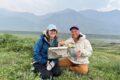
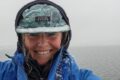
I have been an education professional for thirty years. Currently, I am a middle school teacher at Sunnyside Environmental School based in Portland, Oregon. I center my work around culturally responsive teaching; focusing my students’ voices as critical thinkers who will seek multiple perspectives, problem solve and reason as they consider the challenges and intersectionality of issues facing humans, wildlife and our planet. Hope, resilience and understanding are at the center of this work, ultimately impelling my students to act. My experiences as a photographer and scuba-diver inform my lessons as I strive to blur the classroom walls and connect students to the world around them. My two-years as an ARETS Fellow impacted and expanded my approach to teaching science profoundly.
The Adventure Begins
A fellow teacher, Becca Hawk, had come across the LTER grant program close to the application deadline. Becca teaches the “year of the forest” and I teach the “year of the ocean” and after reading more about the various sites, we decided the opportunity to learn from the scientists doing the research provided an extraordinary opportunity for our 6th-8th grade students. We would be able to bring what we learned in the field to our students as we shared the hands-on labs and research experiences over the next two years. We knew it was too good of an opportunity to pass up and decided to dig in and submit our applications. We checked our email often and to say that we were thrilled is an understatement. We arrived at the HJ Andrews, not sure of what to expect, overpacked, and looking forward to the adventure ahead.
We quickly dragged our bags into our shared housing space and met our fellow LTER first and second year fellows. Following a quick tour of the station we met with Associate Professor Ivan Arismendi and Phd student Tati Latorre from OSU College of Agricultural Sciences, Department of Fisheries, Wildlife and Conservation Sciences, Freshwater Ecology and Conservation Lab. Tati walked us through her current research looking into the impact of the Lookout ’23 fire on the abundance of emerging insects. Together they walked us through the methods used for their research, the questions about burn sites and impact of the fire upstream, midstream and downstream. The stars that night were stunning and I couldn’t wait to be in the field.
Ash Snowflakes
We spent the second day investigating the severity of the burn at different sites along Lookout Creek. The impact upstream was profound: weeping red douglas firs, scorched and fallen trees resembling ancient dragons, and signs of life at every turn. Tati walked us through the traps she was employing to answer her research question. Her willingness to field all our questions and wonderings was much appreciated and she made the science accessible. Our time with her was inspirational and I started thinking about how to incorporate her research and career into our classroom. The difference between the three sites (upstream, midstream and downstream) was highly varied and I was looking forward to taking part in the onsite research over the next two weeks.
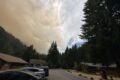
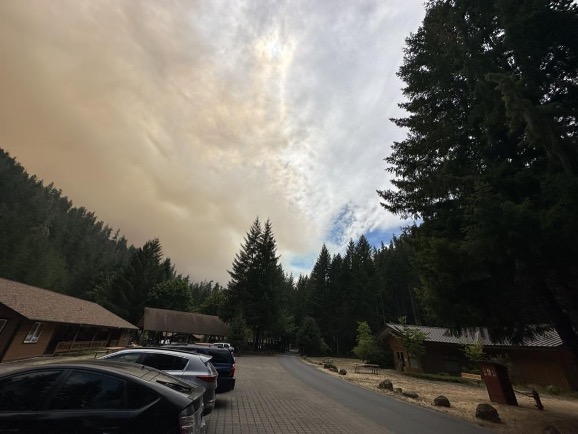
Pulling up outside of the apartment, a helicopter flew low and fast over the dense treetops surrounding the HJ Andrews Experimental Forest, pulling massive buckets overflowing with water. Having just returned to the field station after checking malaise traps along Lookout Creek, we overheard the crackle of conversation announcing the sighting of a burn in the Lookout Forest coming from the emergency radio. When giant singed snowflakes of ash started falling from the air, we were ordered to pack up and evacuate. We drove to Springfield to the La Quinta Inn. As of the following day, the Willamette National Forest had a crew on the now named Ore fire which was burning between 200-250 acres. Additional resources were being sought while 5 crews, 4 engines, 2 dozers, 2 feller-bunchers, 2 helicopters, and 2 water tenders worked to suppress the fire. And it was official, the site was closed to researchers and visitors.
Mayflies, Stoneflies, Caddisflies, Oh My!
With the HJ Andrews closed, we waited to hear what the next steps would be while staying at the La Quinta Inn and eating a lot of chips. It was clear that Kari O’Connell, Ivan, and Joe were working to come up with an alternative and the unexpected opportunity they provided our team has impacted my teaching profoundly. I am so grateful for the time we spent at OSU: identifying and counting insects, visiting the Bug Lab, the tour of the Oregon State Arthropod Collection (the largest collection in the PNW with nearly 3 million specimens), marveling at the opportunity to see the Angler fish among several other wonders in the OSU Ichthyology collection basement of Nash Hall, not to mention the specimens from the OSU Birds and Mammal Collection. Those unique learning opportunities were unexpected and so appreciated!
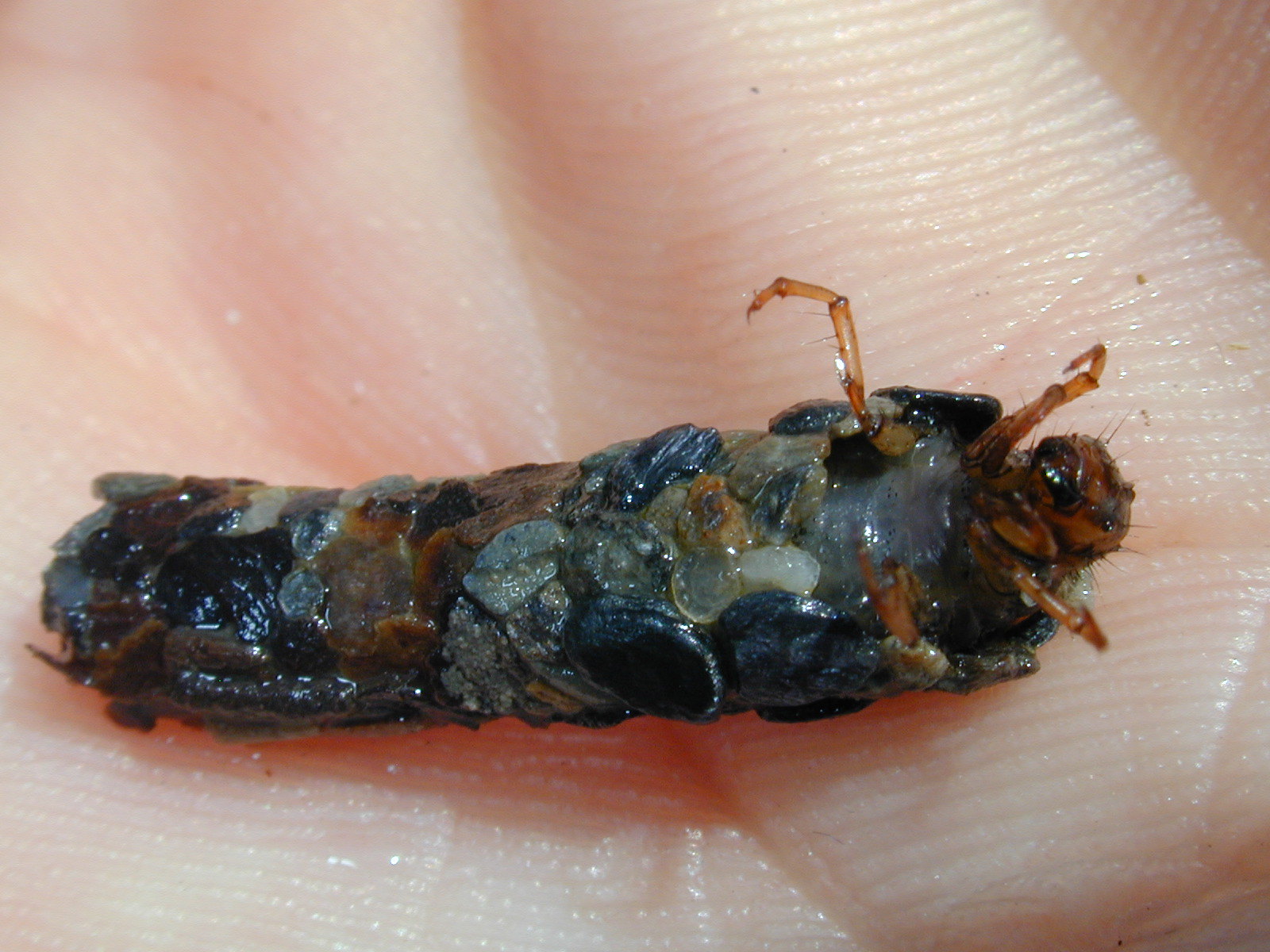
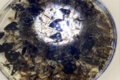
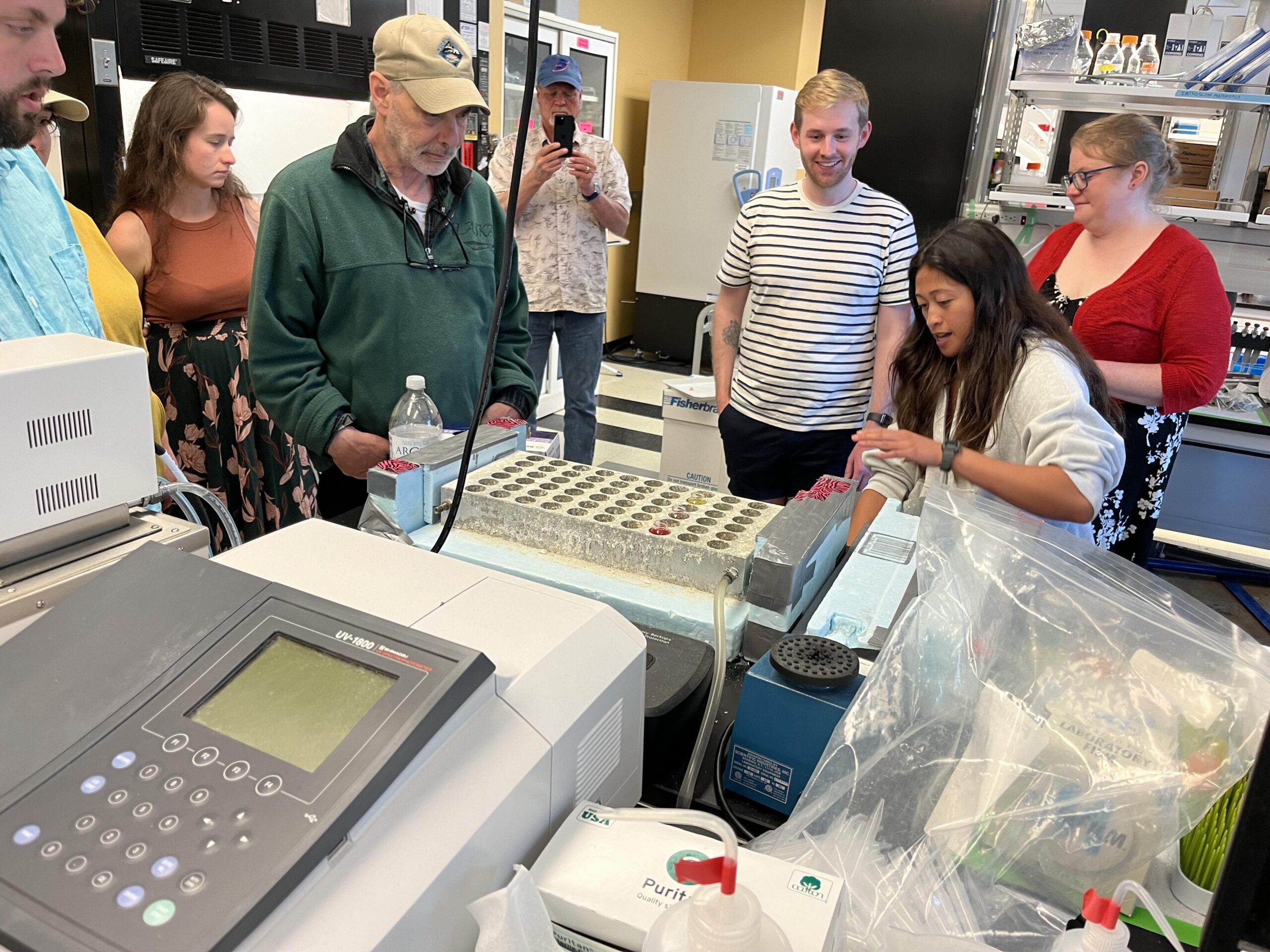
The majority of our time at OSU was devoted to bugs and the learning curve for me was steep! Insect morphology is no joke and Tati’s patience for my constant questions appeared limitless. It took a minute to stop twisting the knobs on the microscopes the wrong way, and to move the petri dish the right direction for a clear visual, but as I got better at it, the faces of the insects and their extraordinary wings and body shapes were compelling. I was inspired to learn more and it was the caddisfly that stole my heart. I loved the underwater casings and outside of the lab found myself reading all about caddisfly zoogeomorphology. The caddisfly would end up becoming front and center in the lesson plan I would be writing. Our time at OSU was a best case scenario and a hard pivot from the initial plans for our research …and it was an experience I will never forget.
Superpod!
Our second summer started at the University of Santa Barbara, where we met up with the teachers from the Arctic and Santa Barbara sites. We came together to hear about one another’s different experiences, to be supported in our Data Nugget planning by Data Nugget founders Liz Schultheis and Melissa Kjelvik. In addition, UCSB professors walked us through data integration topics, there was an R Stats demonstration, and an Excel deep dive. We had the opportunity to learn all about the UCSB Marine Science Institute, which included tours of REEF (Research Experience and Education Facility), and two PhD students welcoming us into their labs and walking us through research. In addition, we were able to see kelp research sites up close and personal, and hundreds of dolphins on a whale watching trip.
It All Comes Together
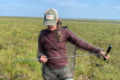
Our second and final summer at HJ Andrews found us reunited with Matthew Retterath, a third-year fellow and the lead on our research project set up by Ivan and Tati. At 8 a.m. and 8 p.m. each day we collected aquatic insects to study the emergence patterns. I was able to utilize the insect identification skills learned the previous year and we again collected and counted. We also had the opportunity to go out into the field with OSU researchers to learn how they set up camera traps and to talk about data that was collected from the Lookout Fire, which supported our Data Nugget Lesson.
When Becca and I applied, I had no idea the depth of experience this extraordinary opportunity would afford us. We were supported by amazing people at every turn. Kari O’Connell fielded every question I had, was profoundly patient with my work and tirelessly supportive of our ideas and requests. The experiences she, Ivan, Tati and Scott curated for us were truly once-in-a-lifetime possibilities.
The number of people we met and learned from in various fields of science have impacted my teaching and shaped how I approach the lessons I teach the 6th-8th middle schoolers in Year of the Ocean. Their passion for science, willingness to invite us into their labs, the field station in the HJ Andrews Experimental Forest and universities will be something that I will never forget and I will continue to channel what I learned and experienced hands-on into my classroom.
Read more about participant experiences with the Authentic Research Experiences for Teachers @ LTERs (ARETS) and access the lesson plans they developed below.
Traci Kennedy
...toward the end of our unit, students were able to create their own graphs, and understand the implications of the...
Stephanie Dolan
This experience reignited my passion for working with students. Witnessing curiosity, perseverance, and the realities of field research firsthand reinforced...
Rebecca Hawk
This experience changed my teaching life! Now we learn about insects, collect insects, and identify insects...We even make our own...
Rachel Rigenhagen
...not only were we able to help contribute to the data being collected but also bring that experience back to...
Paige Shelton
I will have my students work with science data more frequently in our classroom. Whether it is collecting data in...
Melissa Moore
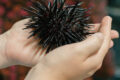
My students tested whether urchins kept indoors or outdoors consumed more kelp. The students got a taste of real, locally-relevant...
Kim Leslie
I fell in love with Amanda Young’s circle graph examples today. I saw them as awesome gateways for students to...
Jacob DeGroot
Understory plot with grid overlay. H.J. Andrews, Summer 2023. Credit: Jacob DeGroot. During my ARETs @ LTERs experience, I spent...
Emily Chittick
The biggest impact of this experience is in how I teach the process of science. While I was at the...
Claire Gunder
...what was so special about this program was that it introduced me and my students to a place in the...
Caroline McCoy
My two years as an ARETS Fellow profoundly changed how my students and I talk about science, approach a question,...