This post is part of the LTER’s Short Stories About Long-Term Research (SSALTER) Blog, a graduate student driven blog about research, life in the field, and more. For more information, including submission guidelines, see lternet.edu/SSALTER
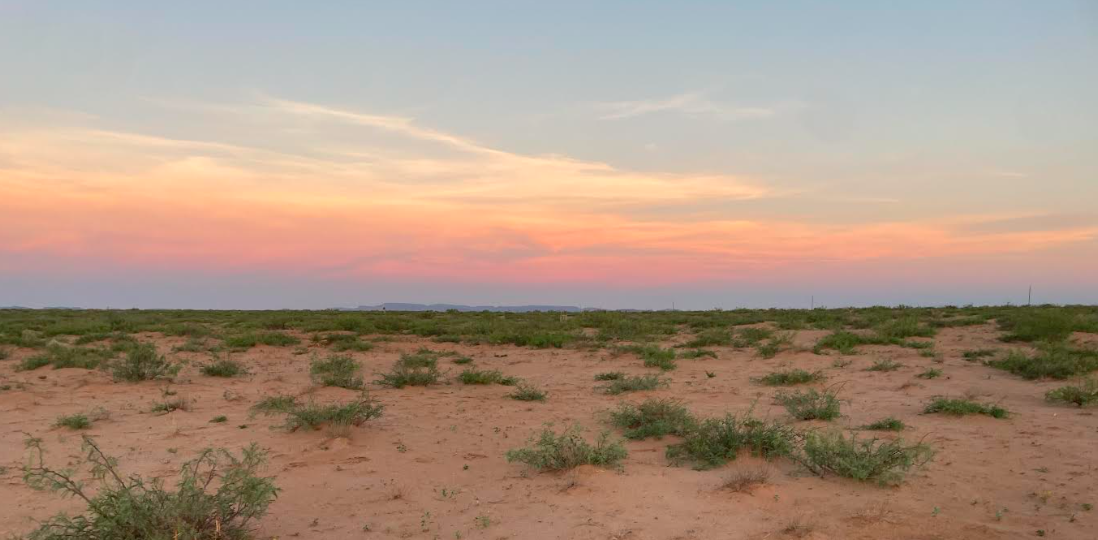
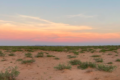
A view of the sunrise at the Jornada Basin. Credit Mary L. Sanchez.
It’s August 2024 as my research partner, Sarah Koger, and I get ready to begin fieldwork at the Jornada Basin LTER site. It can get very hot in the summer months, so we make sure to drive to our field site before the sun comes up to race the heat. Despite the lack of sleep, we are in good spirits after being treated to a beautiful sunrise that stretches across the vast desert landscape.
Biocrusts: The living skin of the earth
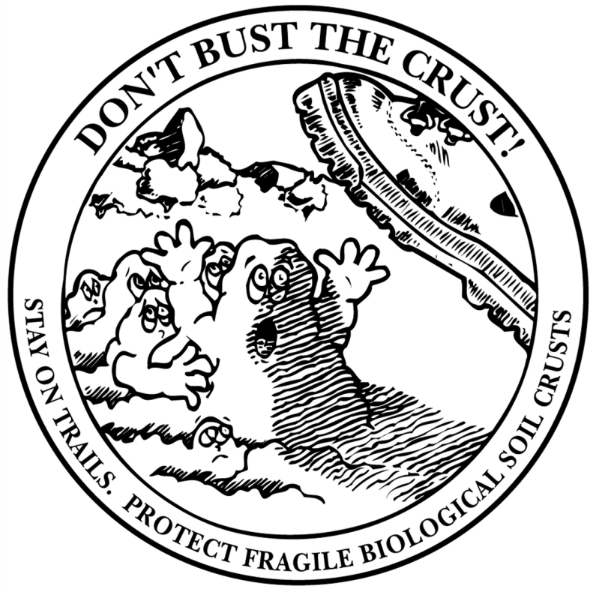
An illustration of personified biocrust. Credit: Arches National Park Service
The soft light from the sunrise is optimal to spot inconspicuous patches of biocrust, the star of our fieldwork for the day. Biocrusts are photosynthetic communities that stabilize and provide nutrients to the soil underneath them. You may have seen signs warning against disrupting these crusts if you’ve hiked in southern Utah with the slogan “Don’t Bust the Crust!”. There are many types of biocrust, but the type our lab is the most interested in are “cyanocrusts” which are dominated by cyanobacteria.
Hunting for crust
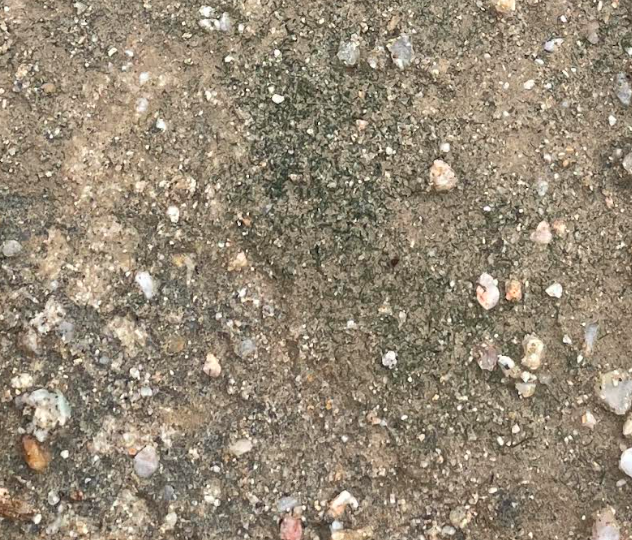
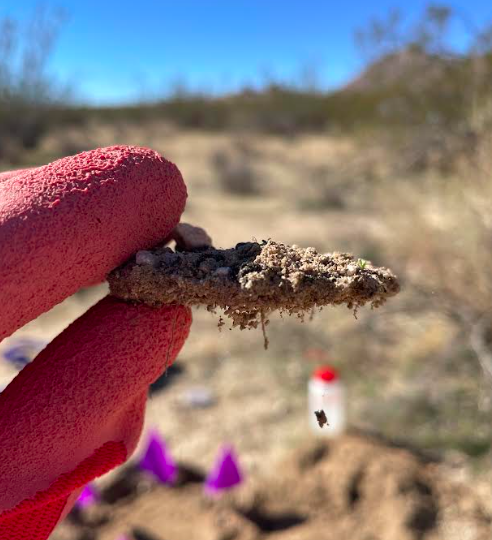
To look for biocrust, we quite literally look for any crust we can see on the ground. It can be easy to mistake physical crust for biocrust, so we try to spot any dark brown pigments on the ground. This color signals to us that sunscreen pigments produced by cyanobacteria are present; these yellow/brown pigments help protect the bacteria from UV damage. Another color signal we look for is green. When wet, the cyanobacteria in biocrust become active in a matter of seconds and cause the crust to “green up” due to photosynthesis performed by the bacteria. Lastly, if we are still not sure if what we are seeing is biocrust, we pick up a piece to see if we can find what we call “danglies”, which are filaments made by cyanobacteria.
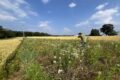
Biocrust greening up after a rain event. Credit: Mary L. Sanchez.
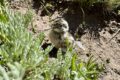
Researcher holding a piece of biocrust, filaments formed by cyanobacteria can be seen dangling underneath. Credit: Mary L. Sanchez.
Busting the crust (for research purposes)
Sarah and I quickly find a good spot with ample biocrust to sample from, a task that is easier in a desert ecosystem like the Jornada Basin. We are ready to start sampling using creative methods we’ve had to troubleshoot for our specific field goals. My field work today requires me to transplant plots of biocrust from the Mojave and Sonoran Desert to the Jornada and to sample crust from Jornada to later transplant to those respective deserts as well. The purpose of these reciprocal transplants is to perform a long term study to see how the different precipitation regimes of these deserts impact the microbial communities of the different biocrusts. To perform these reciprocal transplants, I had to configure a special type of soil corer to extract and transport my plots. Inspired by my advisor saying I needed to essentially create a “huge cookie cutter” for biocrusts, I use cake molds and sheets of steel to sample the plots I need for my project.
Sarah is also doing fieldwork for her project. She studies biocrusts’ role in carbon sequestration by measuring the carbon content of the soil underneath the crusts. To do this, she also has to get creative with her sampling materials. After collecting crust and soil with soil cores, she uses an old face wash bottle to push the soil out from the top of the core to obtain soil samples from varying depths.
The different goals of our fieldwork remind me that although biocrusts are small and thin, there is so much to learn about these powerful microbial communities and the roles they play in desert ecosystems. We are excited to see what the Jornada Basin will teach us!
Bio: Mary Lilibeth Sanchez is a 2nd year Environmental Life Sciences PhD student in Dr. Ferran Garcia Pichel’s lab at Arizona State University. Her research with the Jornada Basin LTER studies how soil microbes in desert environments are impacted by changing precipitation regimes.