–by Rachel Rigenhagen
I teach high school science at a project-based charter school in St. Paul, Minnesota. I had the amazing opportunity to travel to Toolik Field Station, over several weeks, during the summers of 2024 and 2025. The ARETs (Authentic Research Experience for Teachers) program, funded by NSF, was made known to me via a colleague at my school. We traveled together to the Arctic Circle and brought back a plethora of science research and knowledge, unique experiences and fond memories to our students in Minnesota. But what made the experience truly meaningful was not learning the science—but the joining of the scientific community.
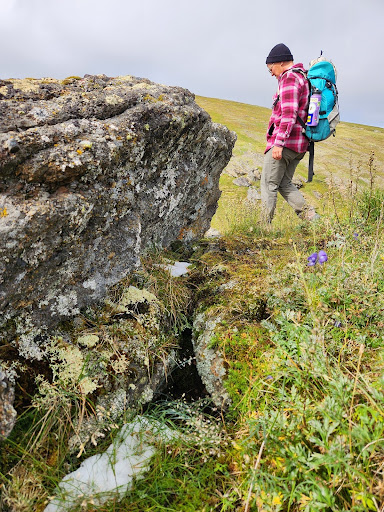
Life at Toolik was immersive, from the moment we arrived after a 15-hour van ride up the Dalton Highway until we departed via the oil fields at Prudhoe Bay alongside the Arctic Ocean. Our days were shaped by field experiences with different researchers, each happy to explain their part in the larger work of long-term ecological data collection. We began each day filled with coffee and a hearty breakfast to head into the field wearing our rubber boots, bug shirts and backpacks holding bear spray…just in case.
The research experience was eye-opening, to say the least. As we helped collect thaw depth data, counted pollinator visits and took water samples along gullies, we observed the meticulous process of taking measurements, repeating them over and over again, looking for variations and then discussing possible explanations. As a teacher, students often think we ‘know’ everything or should be able to explain every possible question they pose. It was refreshing to remember how science begins with ‘not knowing’. This renewed appreciation for the process of inquiry, that science is a way of asking about the world around us, was a humbling encounter.
One of the most powerful tools I was able to bring back from Tooklik was the ability to tell vivid, firsthand stories about scientific exploration. Instead of telling students about some far-off abstract research about the Arctic tundra, I was able to describe how the data was collected, what it felt like walking on the spongy tundra and about the never-ending noise of the mosquitos buzzing in my ears. For my students, these stories transform scientists from distant, nerdy experts into real people that are curious, collaborative and sometimes barefoot, as they collect real measurements and write ‘old school’ with paper and pencil.
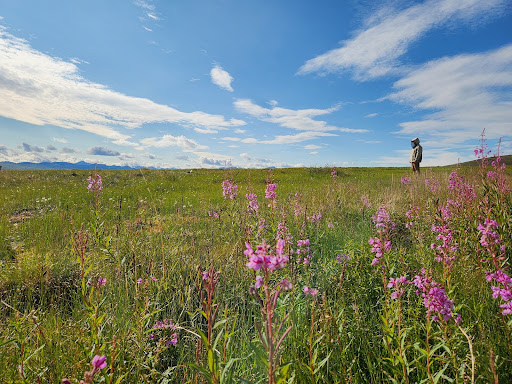
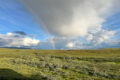
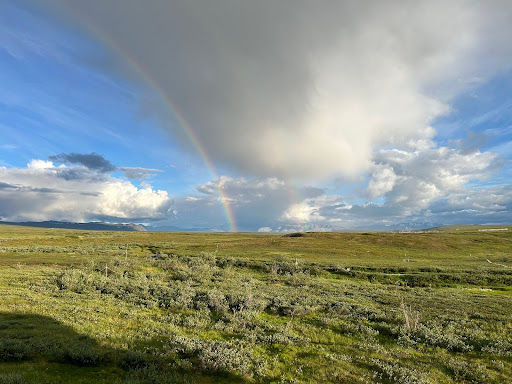
While Alaska and Minnesota may appear worlds apart in terms of their ecological habitats, they share a surprising number of connections. The rolling hills of the vast tundra look and feel much like rolling hills of a native MN prairie. There are a surprising number of plants on the tundra that mimic prairie relatives in their flower and leaf structure. My colleague wrote an entire ecology unit on the parallels between tundra and prairie ‘shrubification’ and the unique causes in each location. Even the name of the field station itself, Toolik, means “loon” which is Minnesota’s state bird.
Drawing parallels helped our students connect global processes to local impacts, making climate science feel relevant rather than abstract. This spark helped ignite new curiosity in our students. When they saw us not just teaching science but doing science, it caused a shift in their interest and buy-in. It increased student engagement, especially among students that don’t necessarily think of themselves as ‘science people’. The curriculum seemed much more like exploring mysteries, asking questions and finding solutions then memorizing terminology and completing worksheets. I saw students become deeply interested in environmental science and have a greater appreciation for nature.
The partnership between teachers and researchers at Toolik is more than a professional development opportunity. It is a bridge between scientists and educators, a link between two very different perspectives in which we see one cannot exist without the other. Educators would have nothing to teach students if not for the researchers out doing the work of asking, collecting and publishing their work. But what would be the point of all that painstaking work if there was no one to share it with and more importantly, no one to question its validity. By immersing ourselves in Arctic research, we were able to return home with new knowledge and renewed purpose in our work as educators. We have been able to show students that science is alive, dynamic and deeply relevant to their lives. Ultimately, we can plant seeds of wonder and curiosity that can grow into the continued cycle of discovery with the next generation of scientists.