My name is Kim Leslie and I participated in a Research Experience for Teachers (RET) at the Arctic LTER site during the summer of 2024. I had the opportunity to go out with a variety of research teams and worked on projects tackling everything from fire ecology to pollination to vole tunneling to the infamous pluck, all with the omnipresent backdrop of rapid climate change.
A particular dichotomy caught my attention and tickled my funny bone on each and every field experience: the contrast of extreme high tech and low tech, often working in tandem in the loveliest of ways! Let me explain…
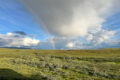
On one of my first days at Toolik Field Station, the team and I made our way along the narrow boardwalks over the delicate tundra vegetation and arrived at a transect study site. The immediate star of the show was a one hundred thousand dollar plus “tram” of sensors that could do an incredibly detailed and accurate plant life census of sorts, slowly moving a few feet above the ground and recording oodles of data. What it was suspended from was a good old fashioned clothesline. Completing the set-up were a healthy amount of bungee cords and the all-important weather protector: a five dollar blue tarp. Together, this motley crew of gear got the job done.
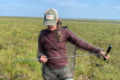
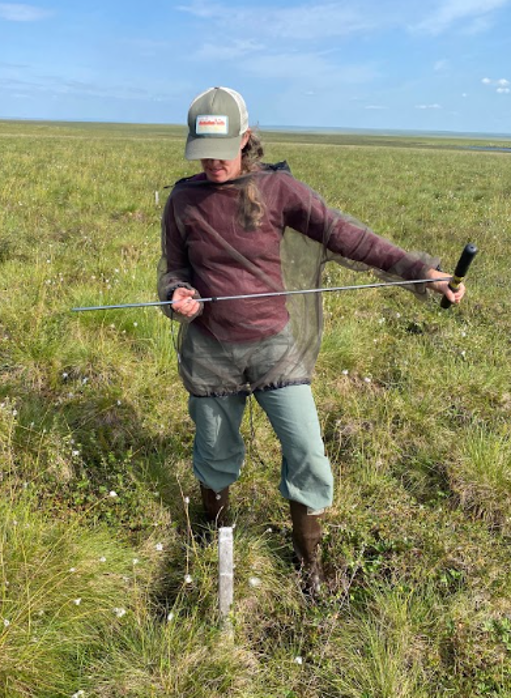
Another day, I got to venture farther afield via fancy helicopter to one of the many tundra burn sites being monitored. Our job was to collect permafrost depth measurements at particular mapped out points. The tool of the day (besides our shiny red transportation) was a steel probe marked with centimeter lines and a T-top handle to easily plunge it down. Simple enough, but I absolutely loved this even simpler innovation: If you wrap a hair tie (you know, one of those thick elastics that long-haired souls use to pull back their manes) at the base of the probe, it will be shoved up the probe by the hard layer of frozen Earth, but not by the more flexible vegetation, thus giving a consistent measurement. One simply needs to pull the probe out of the ground, find where the hair tie is, and record that depth!
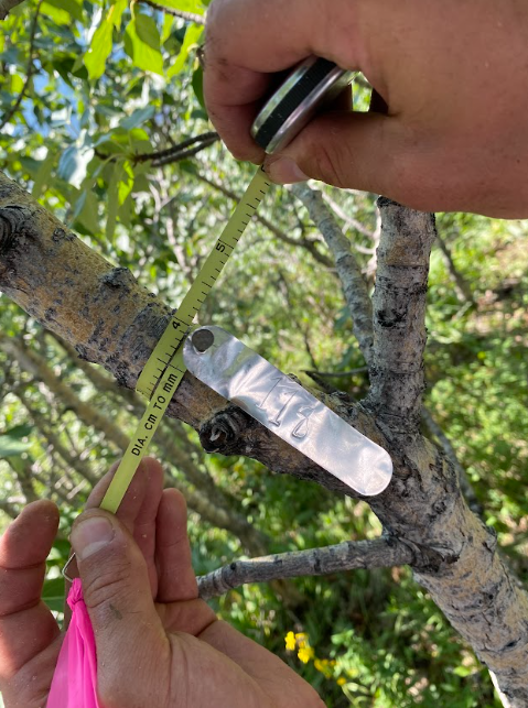
On yet another field excursion, this time across Toolik Lake to a poplar grove, we carried what at first looked like run-of-the-mill measuring tapes. The name of the game was determining the diameter at breast height (DBH) of the trees in an ongoing effort to track their growth and spread. It’s unusual for a true tree versus a shrub to grow this far north and the research group is trying to better understand the poplar population’s success in these Arctic conditions. When it came time to unfurl the measuring tape, one of the graduate students showed me that the markings were already in terms of DBH! Rather than have a regular tape that measured the simple circumference and required us to do the math to calculate the diameter, this tool had it already done for us!
I returned from my Arctic LTER experience full of ideas to implement in my courses as a high school science teacher—but what to focus on first? Memories of all the low tech and MacGyver-style tools I had played with floated to the top and I realized a few important things:
- My understanding of and curiosity about the research projects was so much stronger because I had actually gone into the field and helped live the work; I had touched the ball so I was in the game.
- Sure, some of the studies we participated in required fancy high tech gadgets, but so much of it didn’t. Simple tools and basic measurements done with a clear methodology were at the heart of most of our work. And I could do that work without a lot of training.
- When something proved challenging in the field, good old fashioned human problem solving with physical objects in the moment could overcome obstacles in ways that Google and ChatGPT likely could not (and hey, we didn’t always have service out there).
And here’s the thing: I’m an online high school science teacher. My students work in towns spread over hundreds of square miles, “come to class” at any time of day or night, and view each and every learning task via the Canvas LMS on their computers or phones. But you know what? Those learning tasks can certainly ask students to go outside; to build, find and use appropriate tools; and to do hands-on data collection with the best of them!
So armed with my Arctic LTER data stories as examples, I set about infusing my courses with more opportunities for students to do field work: transect studies in Biology, snowflake photography in Physical Science, temperature measurements in Earth Science. Were the students going to have everything they needed to accomplish the tasks? Probably not. Could they try different tools, make adjustments, and find systems that could work? Indeed. And they had me as a cheerleader, a voice of at least some legitimate experience saying, “Science and data collection doesn’t always have to have flashy gizmos and light speed computers… Methodology, consistency, simple tools and flexible minds are gold in the field. Get out there!”