—by Rebecca Hawk
If you step inside a classroom, there’s a good chance you will meet a group of funny and interesting kids and an adult who loves spending their days with them. This adult probably joined the education field with a heart full of hope or a fond memory of their schooling days. Sometimes these teachers find themselves in a community of other adults and an ecosystem that supports them, inspires them, and pushes them to deepen their own learning. Sometimes that is not the case in their school, but rather it’s something they can find.
I am a really lucky teacher whose school supports me and pushes me to grow my teaching. I teach in an environmental public school in Portland, Oregon, where I teach a mixed subject, mixed grade (6th, 7th, and 8th) middle school class that focuses on the forest. I am so honored to have landed in such a magical place: we go hiking once a week, we get to create a responsive curriculum that feels relevant to our students, current events, and our own interests, and we have academic freedom in a time when that feels more and more rare. The only challenge for me when I arrived at this school was that I did not have an environmental science background. I was previously a middle school English teacher at a traditional public middle school in Massachusetts.
I could not believe my luck when I found the ARETS (Authentic Research Experience for Teachers) LTER program. This program embeds public school teachers with researchers at one of three Long Term Ecological Research Sites (LTER). Our program placed teachers in the Arctic to study the tundra, in Santa Barbara to study the ocean, and at the HJ Andrews Forest in Oregon to study the forest.
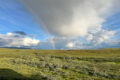
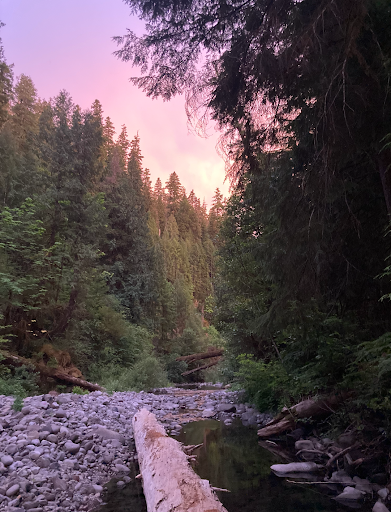
The Andrews Forest is incredible. It is gorgeous–the smell of the trees, the sounds of the creek, and the many, many plants and creatures to feast your eyes on make this a place where you just exhale and find yourself awed. Beyond the natural beauty, the Andrews is a true community. There is a headquarters where you will find a library filled with artists’ work who have spent time creating at the Andrews (this includes authors like Robin Wall Kimmerer, who wrote Gathering Moss while staying at the Andrews). You will find so many posters outlining hundreds of experiments, some ongoing for more than 80 years, that have been conducted at the Andrews.
You will also find the most lovely combination of humans living together in the rustic apartments: scientists, graduate and undergraduate students, techs (who do much of the intensive physical labor involved in collecting some of the data for research at the Andrews), and rangers. These people are all personally motivated; they get themselves up and going on a variety of schedules to make sure their data is collected with integrity, but they are also creating a beautiful community. They hold weekly science talks where different people share and teach others about their work. There is a weekly visit to town to eat and listen to live music. There is much chatter and connection as people make dinner together or hop in the icy creek and wind down from their days out and about in the forest.
Over my two summers in the ARETS program, I had a lot of wild experiences.
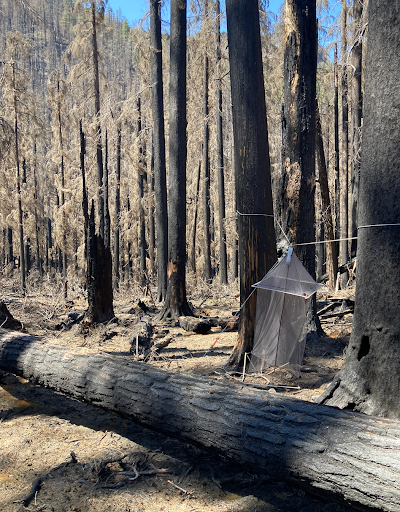
The first summer, we had spent one night at the Andrews. On our second day, we went out into the forest to see sites with different burn severity from the Lookout Fire the previous summer. Ivan Arismendi and Tati Latorre-Beltran were teaching us about their research. Tati studies aquatic insects, and that summer was measuring how prevalent insects were at varying distances from a stream and how that was impacted by the burn severity of an area. We spent our day out with Tati, learning how her insect traps worked, but mostly sketching and observing differences in the environment at different burn sites. The high-severity burn site had such rich oranges (fire moss) and had areas of ground that gave out underneath our feet. I had never physically experienced the aftereffects of fire in a place like that.
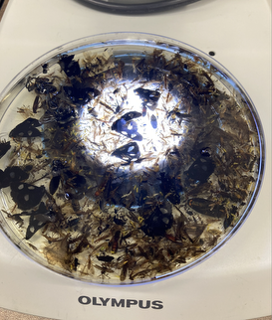
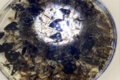
When we returned from our day and were back in our apartment, there was an energy in the air. We turned on the radio and heard in real time as a lightning strike caught nearby and a fire ignited. We were soon evacuated, watching large pieces of ash fall around us like snow and mesmerized by the helicopter that scooped water out of the reservoir to pour over the fire. That was our last day at the Andrews that summer. Ivan and Kari, our program coordinator and biggest supporter, and Joe, a researcher who was taking care of all the ARETS teachers, set us up in a hotel for the night. We waited and learned that while we would not be able to go back to the Andrews Forest to collect aquatic insects with Tati, we were instead invited to stay in the dorms at OSU and spend two weeks helping Tati identify insects that had already been collected. I learned how to really use a microscope to examine an insect’s morphology, I learned about the patience and perseverance needed to accurately collect data, and I learned about all the expert people who spend their lives studying something as specific as Plecoptera (Stoneflies).
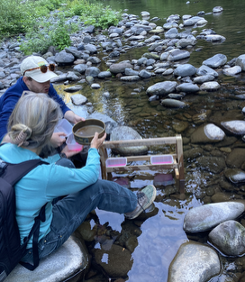
Our second summer, we were not evacuated! Instead, we were able to spend a full two weeks at the Andrews headquarters. This summer, Ivan and Tati set us up with our very own experiment. We collected aquatic insects each day at 8 am and 8 pm to study patterns in the emergence of different species at different times of day. Beyond our collecting, we then used what we learned last summer at OSU to identify all the insects that we collected.
In addition to our two summers at the Andrews (and OSU), this program brought us together with teachers from the Arctic and Santa Barbara twice. The first summer, we all took an online course about using data in our classrooms. The second summer, we all met in Santa Barbara for a week to share our experiences, to support each other in writing lessons for our classes based on our experiences, and to learn about the amazing research happening at UC Santa Barbara (they have really cool Urchin and Giant Kelp research going on).
This experience has been one of the most transformative in my teaching career. I made friends with teachers from other states who I can call for help with ideas (or even to come visit with my class and accompany us on an overnight field trip to the Andrews!). I met researchers whose work I now teach about. Learning their stories, seeing the extremely difficult labor that goes into research, and actually understanding how it works brings such depth to the classes I teach now.
My students are excited to see photos and hear stories about my time at the Andrews and to learn about the people who I call friends. They also now understand the many ways they can be scientists. Lastly, this has brought a deeper interest in policy changes and data literacy so that students truly understand what is going on (who is learning what, who is protecting what, and how we can support the future we want). I will be forever grateful to all the people who took me in and showed me their work, to those who taught me so much about research and data, to those whose excitement is contagious, to the connectors who still support me in getting in touch with researchers and resources, and to the ecosystem at the Andrews that brings us all together.