Claire Gunder

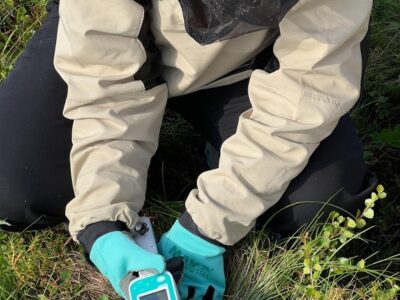
An individual enclosed in raingear and headnet holds a hand-sized instrument over blades of grasslike plants.

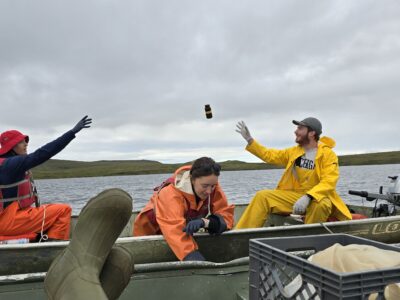
…what was so special about this program was that it introduced me and my students to a place in the world we had once considered foreign, unfamiliar, and completely abstract. It also allowed me to connect this place to our own backyard.

Caroline McCoy

My two years as an ARETS Fellow profoundly changed how my students and I talk about science, approach a question, work together, look for evidence, and most importantly, pick up the pieces when our preconceived ideas are incorrect and comb through our data and ask another question.

Bringing seeds of wonder and curiosity from the Arctic Circle to a Minnesota Classroom

As a teacher, students often think we ‘know’ everything or should be able to explain every possible question they pose. It was refreshing to remember how science begins with ‘not knowing’. This renewed appreciation for the process of inquiry, that science is a way of asking about the world around us, was a humbling encounter.

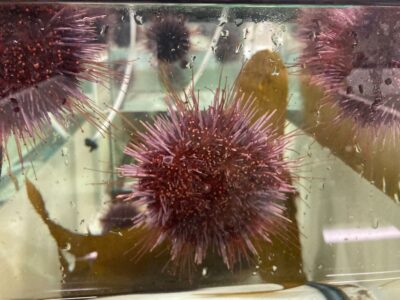
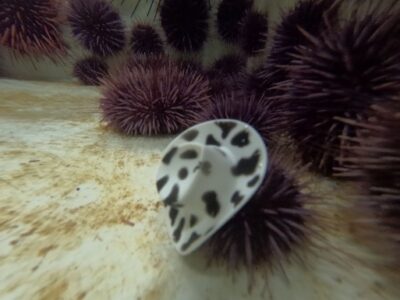
New DataNugget: Do urchins flip out in hot water?

As part of a multi-site Research Experience for Teachers (RET) program, two science teachers, Emily Chittick and Traci Kennedy, from Milwaukee Public Schools, conducted an experiment to see whether warmer water temperatures affected the ability of sea urchins to flip themselves over after being turned upside down. They wrote up this part of their summer… Read more »