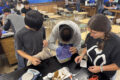
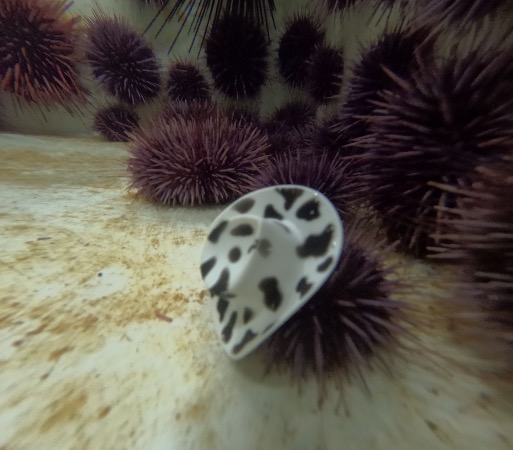
In my ARET research experience, I had the opportunity to travel to beautiful Santa Barbara, California, to work in UCSB’s Marine Science Institute and at the Santa Barbara Coastal LTER (Long Term Ecological Research) site there. I worked with one other teacher, Traci Kennedy, under the guidance of a graduate student, Erin de Leon Sanchez (graduate student), Dr. Gretchen Hofmann (professor), and Scott Simon (director of UCSB’s teaching aquarium, the REEF). They had complementary skillsets: Scott worked with us on the field experiences and the teaching component, while Dr. Hofmann set the direction of the project and answered larger questions, and Erin worked with us on the day-to-day of our experiment: testing urchins’ righting reflex under marine heatwave conditions.
I teach in Wisconsin, where we focus more on freshwater ecology However, the experience at UCSB was invaluable and I brought it into my classroom in two main ways: (1) We used our experimental results to create a Data Nugget, a teaching resource focused on students creating evidence-driven arguments about scientific questions. (2) I pored through some of the massive datasets that the LTER has freely and publicly available, and found some interesting trends for students to examine: Namely, in one area, the population of a specific fish skyrocketed after a marine protected zone was implemented, a great real-life data set for carrying capacity, fisheries management, tragedy of the commons, and so many other concepts I teach. I do want to add a (3) although credit is not mine: Traci partnered with Scott to do a virtual tour of the REEF, an experience she said her students loved.
The biggest impact of this experience is in how I teach the process of science. While I was at the LTER, I spent a lot of time thinking about how science is long and messy. As teachers, we sometimes make the message too “clean” to make a main point – but it’s critical that students grapple with the mess! Where are data missing or outliers? How were these data collected? Can we trust them? I now ask my students these questions often. Furthermore, findings need to be evaluated in context; long-term trends and snapshots are complementary ways of understanding systems. We need enough information to interpret our results in a thoughtful way, and to ask the right probing questions. If students can take away those lessons, they’ll be more engaged, informed, and meaningful agents in their own lives and positive contributors to our communities.
During her research experience, Emily developed 5 lesson plans, as well as a blog post, Hot Urchins: Bringing Kelp Forest Ecology to Midwest Students, about her time with the Santa Barbara Coastal LTER.
Lesson plans: