During the summer of 2024, I had the opportunity to participate in the ARET@LTER project as a teacher in the Arctic at the Toolik Field Station. Every day I went into the field with different research teams and worked on projects tackling everything from fire ecology to pollination to vole tunneling to the infamous pluck, all with the omnipresent backdrop of rapid climate change. Getting to actually do science in the field was absolutely reinvigorating for me as a teacher.
In the past, the majority of my professional development in the realm of education had focused on effective instruction, assessment design, group management techniques, and the list goes on; somehow I had gotten bogged down in the gobbledygook of pedagogy and lost sight of the heart of my discipline: Science! But at Toolik I was donning my boots and rain pants, filling my pack with water and snacks, and marching along with permafrost probes and measuring tape. I was making observations and decisions, taking measurements, recording data, and coming back to analyze that data with a team, all with the knowledge that my contributions mattered to big picture understandings about the changing tundra and more.
Back in my online science classroom, I infused my Canvas LMS courses with opportunities for students to go outside, use easily found or made tools, and take stock of their backyards and communities. When hands-on options weren’t a fit, I leveraged Zooniverse citizen science opportunities so students could contribute to worldwide research from their phones or laptops. And I made data literacy a skill we started building on day one so students were ready for the meatier work ahead. None of these shifts were massive, but they resulted in my students actually practicing science in meaningful ways more than they would have in past iterations of my courses. The ARET@LTER project was a gift to me that ultimately became a gift to my students.
Read more about Kim’s field experience at the Arctic LTER in her blog post, Clotheslines, Hair Ties, and Tape Measures: Low Tech Tools for the Win
Kim also created, piloted and currently runs a Data Literacy Boot Camp Module, accessible to all within the Commons of the Canvas LMS. Beyond the learning tasks themselves, she includes examples of student work and examples of data-focused activities that students can tackle more confidently after their boot-camp experience.
Designed to be used with learners in 6th through 12th grade as an asynchronous introduction to data literacy or as “just in time” training for a subset of a class, the module moves students through a scaffolded flow of learning tasks addressing the different forms data takes, examples and considerations for data visualizations, and data analysis practices. Chunked out, fast paced, rich with teen-friendly examples and providing opportunities for student choice, the goal of the course is to engage, enlighten and inspire.
The idea for this module was born out of my ARET@LTER experience in the Arctic. I was already hooked on learning about data literacy from our pre-trip training with Dataspire’s Kristin Hunter-Thomson. Then, on one of my first days at Toolik Field Station, Amanda Young shared her website that included circle graphs, a data visualization I had never encountered before. I believe my journal entry from that day says it all:
Wednesday, July 17, 2024
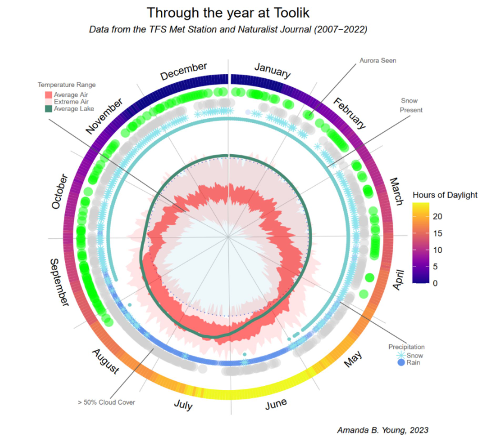
I fell in love with Amanda Young’s circle graph examples today. I saw them as awesome gateways for students to explore visual data in a new/more exciting/artsy way. I imagine using them as phenomena in and of themselves, since they aren’t necessarily obvious nor perfect and leave room for different interpretations and questions. And I can see inviting students, once comfortable with the idea, to make their own for temporal (like seasons or weekly or 24 hour cycles) data.
I’m conjuring a sort of “data decoder” boot camp module that could be used in any of my classes (either as a course prerequisite or an on demand/as-needed for some) and specifically developing a series of circle graph learning tasks towards the end as one option for students to build and apply their data savvy…