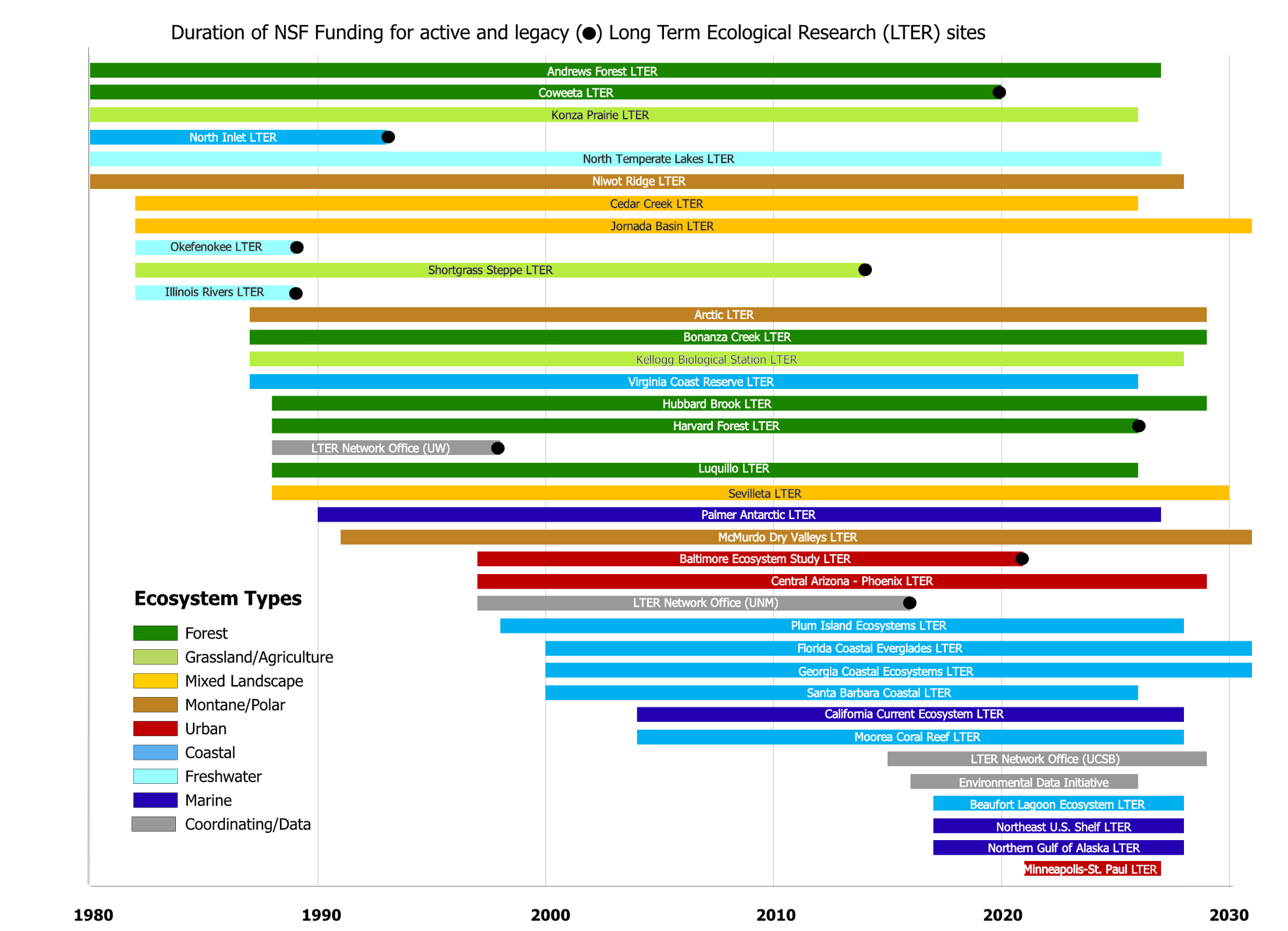
New to the Network? Or just losing track of the various leadership and policy transitions? With more than 40 years of activity, there is a lot to track. The timeline below lays out the major events and changes in the Network’s history, with links to background documents, presentations and publications.
Authentic Research Experiences for Teachers at Long-Term Ecological Research sites (ARET) project launches bringing two-two-year cohorts of teachers to Santa Barbara Coastal LTER, Andrews Forest LTER, and the Arctic LTER.
The 40th anniversary of the LTER Network coincides with the global COVID-19 pandemic, shutting down nearly all research for the summer of 2020 and continuing through the year into the following field season for the more vulnerable Arctic and Antarctic sites.
The decadal review committee is formed and charged by NSF to review the last decade of the Network’s activities.
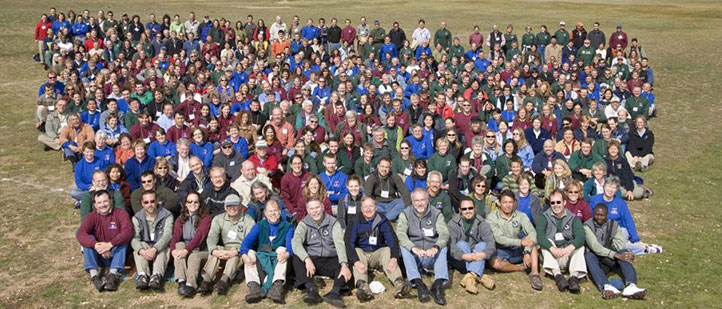
The 2015 LTER All Scientists’ Meeting, From Long-term Data to Understanding: Toward a Predictive Ecology, was held at the YMCA of the Rockies in Estes Park, CO.
LTER Network Communications Office established at the National Center for Ecological Analysis and Synthesis (NCEAS), University of California-Santa Barbara, with Frank Davis as director.
Network Information System releases new LTER NIS Data Portal for accessing LTER Site’s data.
12th Annual LTER-NSF Mini Symposium held in Arlington, VA on February 28, 2013, download and view the presentations at The Globalization of Long Term Ecological Research
On February 28, 2013, the U.S. and French long-term ecological research networks sign a Memorandum of Understanding committing both networks to site and scientist collaborations
Ninth annual LTER-NSF Mini Symposium: Ecosystem Services in a Changing World
The Long Term Ecological Research (LTER) Network is the recipient of the 2010 Distinguished Scientist Award by the American Institute of Biological Sciences (AIBS)
Nancy Huntly replaces Todd Crowl as NSF Program Officer for LTER
NSF initiates 30 Year review of the LTER Program
Communication Committee created
Data Advisory Council formed
Network Coordination Committee created
2009
Eighth annual LTER-NSF Mini Symposium: Ecological Connectivity and Climate in a Changing World: Perspectives from LTER
LTER Network Office funded for cores services with separate ARRA funding for “Support and Cyberinfrastructure Development for Integrated Network Science in LTER”
Henry Gholz goes on sabbatical from NSF
Todd Crowl becomes Program Officer for LTER
LTER/USFS “Clim/HydroDB” database transferred from Oregon State University to the LTER Network Office.
2008
Seventh annual LTER-NSF Mini Symposium: Social-ecological systems in a changing world: Perspectives from long-term ecological research
Agrarian Landscapes in Transition synthesis volume published (OUP)
Ecology of the Shortgrass Steppe – SGS synthesis volume published (OUP)
LTER Network Office submits renewal proposal and receives recommendation for full funding by NSF review panel
Memorandum Of Understanding between the LTER Network and the National Phenological Network for Cooperation in Phenological Monitoring and Assessment
2007
Sixth Annual LTER-NSF Mini Symposium: Cycles of Change in Social-Ecological Systems: Perspectives from Long-Term Ecological Research
LTER Technology Committee is disbanded and duties assigned to the Information Management Committee and the LTER Network Office
The Committee on Scientific Initiatives is formally disbanded and duties assigned to the Science Council
Phil Robertson is elected as Chair of the LTER Executive Board and Science Council
Principles and Standards for Measuring Primary Production volume published (OUP)
LTER Cyberinfrastructure Strategic Plan published
“The Decadal Plan for LTER” published, including an integrated research plan, a description of the EcoTrends project, a Strategic Plan for Education, a Strategic Plan for Cyberinfrastructure, a new governance plan, and Integrative Science for Society and the Environment
2006
Credit: LTER. CC BY-SA 4.0
Credit: LTER LNO
Fifth Annual NSF-LTER Mini Symposium: LTER and Global Change
Fourth LTER (and first ILTER) All Scientists Meeting– Snowbird, Utah in association with the annual meeting of the Ecological Society of America
LNO hires William Michener as Associate Director for Project Development with the initial task of strengthening the relationship between LTER and the Organization of Biological Field Stations (OBFS)
Scott Collins becomes Program Officer for the National Ecological Observatory Network (NEON); Henry Gholz becomes the Program Officer for LTER at NSF.
LTER Network and San Diego Supercomputer Center strengthen bonds by employing joint research staff
NSF Announces special LTER competition for land margin sites
Tom Callahan, long-time NSF program director and LTER supporter, passes away
Knowledge and Distributed Intelligence Grant Funded: LTER Network Office, NCEAS, SDSC, and University of Kansas collaborate on the Knowledge Network for Biocomplexity
Standard Soil Methods for Long Term Ecological Research published (Oxford University Press)
1998
NSF proposal competition results in addition of new Land Margin Ecological Research (LMER) site: Plum Island Ecosystem LTER
LTER Network signs contract to produce Science Synthesis Series with OUP
Konza site volume published (OUP)
McMurdo site volume published (AGU)
Schoolyard LTER Supplements added to LTER grants ($15k/yr to each site)
Publication of LTER site brochures initiated by the LTER Network Office
1997
NSF holds competition for new Land Margin LTER sites
NSF announces special proposal competition for urban LTER sites
March 15: Network Office officially begins operation from the University of New Mexico:
Jim Gosz – P.I..
John Vande Castle – Co P.I.
James Brunt – Co P.I.
LTER Network Office hosts special session of ESA: “Long Term Research in Ecology – Cross-Site Collaborations for the Future”
October 15 – Bob Waide becomes Executive Director of the LTER Network Office
Christine French from the Office of International Programs at NSF is posted to the Network Office
NSF proposal competition results in addition of two new urban LTER sites:
Central Arizona Phoenix
Baltimore Ecosystem Study
1996
Two LTER Sites Augmented with funding for regional-level research (CWT and NTL)
Palmer site volume published (AGU)
1995
Credit: Stephanie Martin
Coordinating Committee Chair Jerry F. Franklin announces his retirement as Chair after more than 12 years of service
James R. Gosz is elected LTER Coordinating Committee Chair
LTER National Advisory Board established
Scott Collins replaces Tom Callahan as NSF program officer for LTER
International LTER (ILTER) Network expands membership; James R. Gosz elected ILTER Network Committee (formerly Steering Committee) Chair
LTER Publications Committee develops plan for publication of Network research synthesis volumes
NSF announces open competition for LTER Network Office cooperative agreement
NSF announces the 1995 special competition for cross-site comparisons and synthesis at LTER and non-LTER sites. Thirteen awards ranging from $150,000 to $200,000 are given.
1995 NSF/DOE/NASA/USDA Joint Program Awards, Terrestrial Ecology and Global Change (TECO), are announced. There are seven LTER recipients, including researchers at Bonanza Creek, Cedar Creek, Central Plains, Harvard Forest, H.J. Andrews and Jornada.
1994
NSF announces a special competition for cross-site comparisons and synthesis at LTER and non-LTER sites as well as international research awards in response to the 10-year review of the LTER Program. Nine grants ranging from $109,353 to $200,000 are awarded to LTER and non-LTER U.S. sites, and sites in Ireland, Scotland, Costa Rica, Argentina and Russia.
NSF announces a special competition for augmentation of LTER projects for regionalization, comprehensive site histories, and increased disciplinary breadth. North Temperate Lakes and Coweeta Hydrologic Laboratory receive awards of $499,959 and $498,906, respectively.
LTER Network assesses leadership and governance in response to 10-year review and in preparation for the election of a new Coordinating Committee chair
LTER Publications and Synthesis committees established
LTER Network World Wide Web site established at Network Office
First International LTER (ILTER) Steering Committee meeting, Rothamsted, U.K.
NSF and U.S. Forest Service sign a Memorandum of Agreement to cooperate/collaborate in LTER Program research
NSF and the National Biological Service sign a Memorandum of Agreement to cooperate/collaborate in LTER Program research
1993
NSF Antarctic research proposal competition results in addition of new McMurdo Dry Valleys, Antarctica LTER site
International LTER Summit held (Argentina, Brazil, Australia, Canada, Chile, China, Costa Rica, France, Hungary, Mexico, Mongolia, New Zealand, Russia, Taiwan, United Kingdom, and the United States represented)
International LTER (ILTER) Network established, Jerry F. Franklin (U.S. LTER Chair) is elected ILTER Steering Committee Chair
LTER Network Internet (gopher) server established at Network Office
LTER All-Site Bibliography developed and put online in searchable form
LTER Core Data Set Catalog put online in searchable form
LTER Personnel Database put online in searchable form
North Inlet LTER site withdrawn; 18 LTER sites remain in Network
1992
NSF announces new Antarctic LTER site competition with funds from Polar Programs and Environmental Biology divisions
LTER Coordinating Committee, at the request of NSF, develops an eight-year vision–LTER 2000–for the creation of a global environmental research network based upon approaches established in the LTER Program
1991
NSF Antarctic research proposal competition results in addition of new site:
Palmer Station, Antarctica LTER
Geographic Information Systems (GIS) working group analyzes the status of LTER Network technical supplements and assesses future technical needs (recommends enhanced Internet connectivity, individual site remote sensing capability, annual acquisition of remote sensing data, site archival storage capability, additional GPS units, enhanced site database software capabilities, automated field data collection)
Global Positioning Systems (GPS) units acquired for shared LTER site use and GPS training provided for representatives from all sites
Network Office creates Communications System Analyst position
1990
NSF announces Antarctic LTER site competition, supported by funds from Polar Programs and Environmental Biology divisions
Second LTER All Scientists Meeting, Estes Park, CO
LTER Network Office establishes LTER Geographic Information Systems/Remote Sensing Laboratory at University of Washington-Seattle
Franklin, J.F., C. Bledsoe and J.T. Callahan. 1990. Contributions of the Long-Term Ecological Research Program. BioScience 40:509-523.
1989
NSF conducts national LTER Program review
Coordination grant is awarded to University of Washington-Seattle (Jerry Franklin, PI). LTER Network Office enlarged and established on the University of Washington campus, in the College of Forest Resources.
Network Office creates Publications/Public Information Coordinator position
Network Data Manager (Rudolf Nottrott) is hired and Network-wide electronic mail forwarding system is developed. LTER personnel database from NSF is incorporated.
LTER Technology Committee identifies and recommends technology requirements and criteria to meet primary LTER Network research goals (global change assessment and comparative studies of ecological phenomena and theories). Report entitled “LTER Technology Report for the LTER Strategic Plan” is referred to as “Gosz Technology Report” after chair Jim Gosz.
LTER working group develops “Global Change Research Action Plan”
LTER Network electronic bulletin board established at Central Plains Experimental Range site
Network Office hires Program Assistant for meeting and travel coordination
Network Office hires John Vande Castle as Network Manager and acquisition of satellite imagery and aerial photography for all sites begins
First issue, Databits, LTER data managers electronic newsletter
LTER-Chinese Ecological Research Network (CERN) exchange/collaboration develops
NSF proposal competition results in addition of three new sites:
Luquillo Experimental Forest
Sevilleta National Wildlife Refuge
Harvard Forest
and two are withdrawn (Illinois Rivers and Okefenokee)
NSF Advisory Committee on Scientific & Technological Planning for LTER identifies scientific issues addressed by the sites and recommends Network-wide capabilities to address them. Report is referred to as “Shugart Report” after chair H.H. Shugart.
LTER Climate Committee reviews research and understanding of climate variability and ecosystem responses of the LTER sites (Greenland and Swift 1990)
NSF creates LTER Research Coordinator position at Division of Environmental Biology to encourage LTER cross-site research efforts (Caroline Bledsoe hired)
First comprehensive directory of LTER personnel is compiled by Bob Robbins and Caroline Bledsoe at NSF and printed at the LTER Network Office
John L. Brooks, a key developer and supporter of the Long- Term Ecological Research Network, retires from the National Science Foundation
1987
An NSF proposal competition results in five new sites added:
Steering Committee creates a policy for workshops supported under the coordination grant
1981
Dick Marzolf (Konza Prairie) serves as first LTER Steering Committee Chair. NSF awards a coordination grant to Kansas State University (with Marzolf as PI).
An NSFproposal competition results in five new sites added:
Central Plains Experimental Range (now called Shortgrass Steppe)
Okefenokee
Illinois Rivers
Cedar Creek Natural History Area
Jornada Basin
1980
An initial set of six sites is selected from proposals submitted and funded at $300,000 per year:
North Temperate Lakes
H.J. Andrews Experimental Forest
Coweeta Hydrological Laboratory
Konza Prairie
North Inlet Marsh
Niwot Ridge
LTER lead scientists meet in Washington, D.C. and constitute a steering committee to begin the tasks of LTER communication and coordination and accommodation of mutual goals
NSF announcessecond call for long-term ecological research proposals
1979
NSF announces a call for proposals for pilot projects in long-term ecological research with goals of 1) initiating the collection of comparative data at a network of sites representing major biotic regions of North America, and 2) evaluating the scientific, technical and managerial problems associated with such long-term comparative research.
The NSF sponsors the third workshop to initiate and maintain close consultation with the ecological sciences community.
The National Science Foundation (NSF) sponsors workshops to initiate and maintain close consultation with the ecological sciences community. At these workshops the philosophy of collaborative research is developed and a centralized working hypothesis approach to collaboration proposed. Five core areas of research are defined to orient long-term ecological research projects toward question/hypothesis formulation and resolution over long time and broad spatial scales.