This post is part of the LTER’s Short Stories About Long-Term Research (SSALTER) Blog, a graduate student driven blog about research, life in the field, and more. For more information, including submission guidelines, see lternet.edu/SSALTER
When Night Falls in El Yunque
Credit: Credit: Leonardo Rivera Pagan.
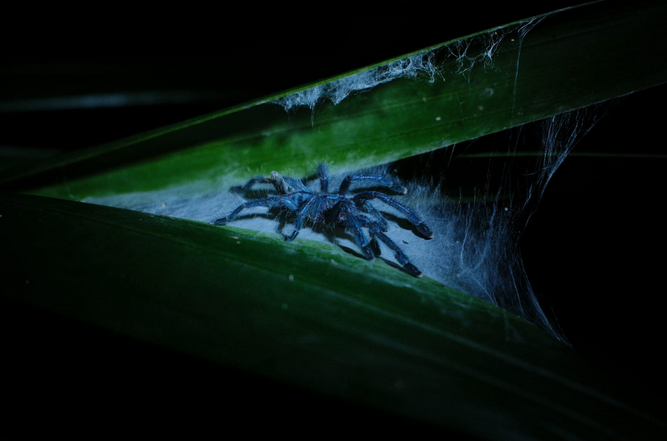
In the forests of El Yunque at night, species that are rarely seen during the day appear in astonishing abundance. Bioluminescent fungi glow softly along decaying logs. Velvet worms (onychophorans) crawl slowly across wet leaf litter. Blue tarantulas, click beetles, and other strange and beautiful insects emerge from hiding, accompanied by a chorus of thousands and thousands of frogs.
As a second year doctoral student at the University of Puerto Rico, the opportunities presented at the LUQ-LTER site have allowed me to better explore the natural history of my home island. I had the opportunity to perform a bio-acoustic survey of those very same frogs at the LUQ-LTER’s Long-Term Elevation Plots (LTEP).
Credit: Leonardo Rivera Pagan
Studying the Luquillo Gradient
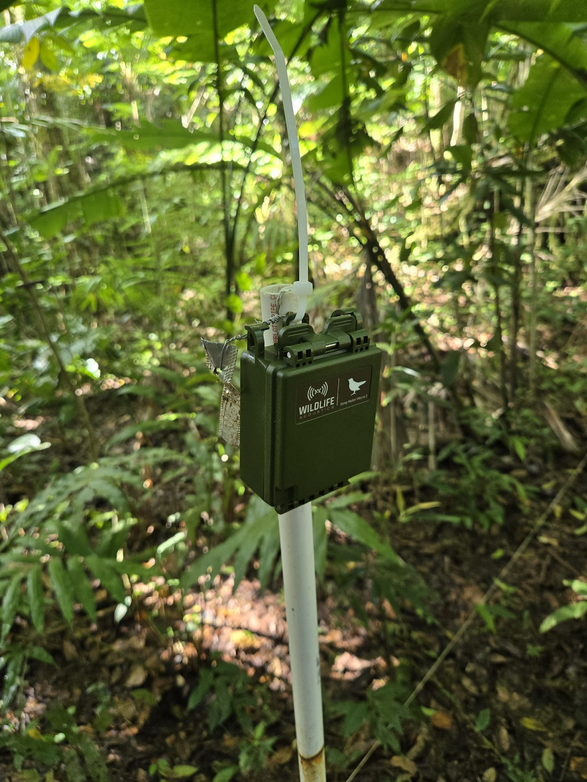
The LTEP spans the full elevational gradient of the Luquillo Mountains, capturing the island’s four major forest types: tabonuco forest at lower elevations, followed by palo colorado, and finally elfin forest near the peaks, as well as slopes of palm forest scattered throughout. From the months of November through March, I deployed acoustic recorders across the Luquillo Mountains to better understand how frog communities change with elevation and how those patterns may shift through time.These devices recorded continuously, day and night, allowing us to “listen” to the forest even when no one was physically present. Along this gradient, I deployed recorders at 30 sites, from 250 to 1000 meters in elevation, in 2 distinct trails, the “palm” trail and the “mixed tree”.
Why Frogs?
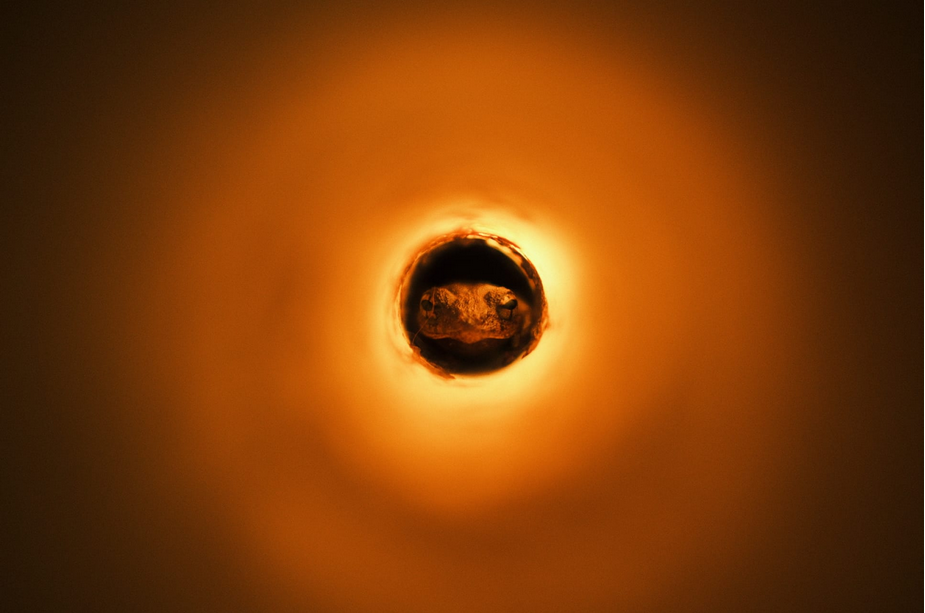
You may ask, why frogs? Well, in Puerto Rico, our 14 species of frogs (all members of the Eleutherodactylus genus) form the biggest concentration of animal biomass on the island. These frogs, colloquially called coquis due to the distinctive “co-quí” sound the most common species makes when calling at night, serve as a symbol of Puerto Rican identity. Their nightly calls are a familiar sound of Puerto Rican landscapes, and they are frequently represented in Puerto Rican folklore, art, and national symbolism. They are also sensitive to environmental conditions such as temperature and humidity, making them excellent indicators of ecological change. Their calls are also species-specific, which means we can identify who is present simply by listening carefully. Upon data collection, the many hours of recordings were analyzed to identify which species occupy at each elevation and how frog communities change as the forest transitions up-slope. Based on previous work and current knowledge, I expect to find abundant species such as Eleutherodactylus coqui, E. wightmanae, E. portoricensis, and E. unicolor across much of the gradient. One of the most exciting possibilities, however, is detecting more elusive or less frequently observed species, those that are rarely seen but may still be calling in the darkness.
Credit: Leonardo Rivera Pagan
A key component of this project is its long-term perspective. These same plots were surveyed acoustically in 2017, providing a rare opportunity to compare frog distributions nearly a decade apart. By pairing bio-acoustic data with climatological information, this work aims to explore whether changes in temperature are associated with shifts in frog diversity and elevation ranges over time. While much of this research is now happening behind a computer screen, the fieldwork itself was unforgettable. Ascending the forest at night reveals a completely different forest. Familiar trails feel alien. The forest breathes, clicks, chirps, and hums. The soundscape becomes dense and layered, dominated by frog calls but punctuated by insects, rustling leaves, and the occasional unexpected noise.
Credit: Leonardo Rivera Pagan
Why Long-Term Research Matters
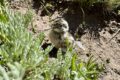
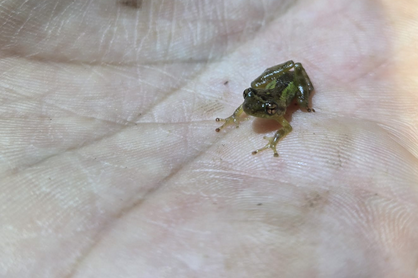
On one particularly memorable night, I was lucky enough to encounter Puerto Rico’s only green frog, the cricket coquí (Eleutherodactylus gryllus). At first only hearing a faint chirp in a patch of ferns, I began searching, illuminated only by a headlamp, until suddenly I spotted this miniscule frog, smaller than a fingernail perched quietly on a heliconia plant. Seeing this served as a reminder of how much remains hidden in these forests, and all that we still have to learn.
Projects like this highlight the importance of long-term research sites like LUQ-LTER. Without permanent plots, historical data, and sustained monitoring, it would be impossible to ask questions about change across years or decades, such as the shifting dynamics of amphibian populations in response to climate change, or how the composition of invertebrate fauna changes in areas where these frogs are no longer found. By listening to frogs along the elevation gradient, we gain insight not only into amphibian communities, but also into how tropical forests respond to a changing climate.
Sometimes, the best way to understand an ecosystem is simply to stop and listen.

Leonardo is a second-year doctoral student in ecology at the University of Puerto Rico, Río Piedras, studying tropical amphibian ecology with a particular emphasis on Puerto Rico’s iconic coquí frogs (genus Eleutherodactylus). Working within the Luquillo Long-Term Ecological Research (LUQ-LTER) program, Leonardo is studying how environmental gradients, especially elevation and temperature, shape anuran population dynamics and acoustic communities.
Leonardo shares fieldwork and research experiences through Instagram, @leooo_rivera1, where they maintain a visual diary of work and life in the field and in the lab.