This story appeared first on the Kellogg Biological Station LTER website. Watch the recording of the related LTER community call here.
A collaboration between postdocs and graduate students at the KBS, Konza Prairie, and Cedar Creek LTER sites synthesized nearly forty years of grassland research while building long-lasting personal and professional connections.
Collaboration is at the heart of the LTER Network. While each of the 26 sites works independently to generate valuable long-term datasets, the Network brings these sites together to put data into a broader context, ask new questions, and uncover patterns that might otherwise go undiscovered.
A recent collaboration between the KBS LTER and two other sites demonstrates how these partnerships can do more than drive scientific discoveries. They can also create opportunities for graduate students and postdocs to develop new skills and establish relationships that can last their entire careers.
The idea took shape at the 2022 LTER All Scientists Meeting in California, where researchers from across the LTER Network met and exchanged ideas. There, three of the grassland focused sites – KBS, Konza, and Cedar Creek – began to discuss how their shared focus on grassland ecosystems makes them a natural fit for asking collaborative questions about how these systems respond to environmental change.
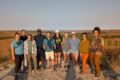
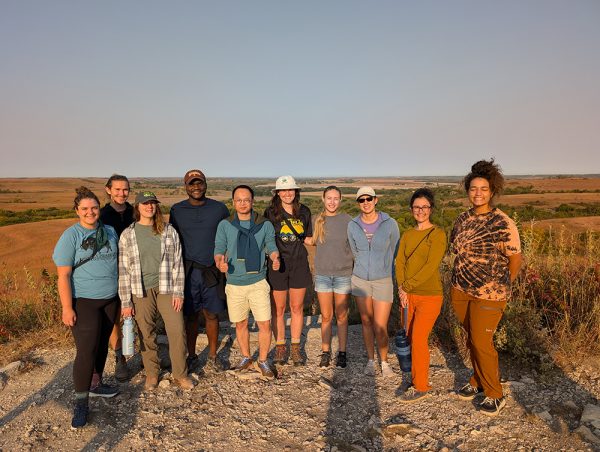
Soliciting interest from grad students and postdocs at each site to form a working group that would synthesize long-term data from all three sites to address questions of common interest. Organized by KBS LTER Co-Director Nick Haddad, Science Coordinator Nameer Baker, and MSU Professor Lauren Sullivan, the team gathered in person to begin the collaboration. The group first met in September 2023 at the All Scientists Meeting held at KBS, followed by gatherings at Konza Prairie LTER in October 2024 and Cedar Creek LTER in May 2025.
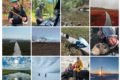
These in-person meetings provided time not only to discuss research, but also to build personal connections with other researchers through social events like barbecues and line dancing. Nameer Baker recalls how readily the graduate students and postdocs began exchanging ideas and working together.
“One of the best ways to encourage good science is to bring people together early in their careers and orient them around a common goal,” he said. “Not only did everyone involved generate new and exciting science, but they also created a strong network of collaborators within their discipline that they’ll benefit from for a long time in their career.”
Between meetings, regular video conferences kept the momentum going and allowed the group to eventually narrow its focus to grassland plants and climate, specifically how species diversity and composition impact ecosystem ability to respond to extreme climate events. Although the initial working group included a broad range of participants, the increasingly specific research questions and decisions about project leadership meant that some members ultimately stepped away.
The working group produced two great outcomes. The first was a research paper, published in Ecology Letters in April 2026, that drew on nearly four decades of data from the three LTER sites and included 15 collaborators. The study highlights the importance of considering multiple plant community properties, along with nutrient addition, when predicting ecosystem response to extreme wet or dry events. Notably, the harmonized dataset that the group produced is also published via EDI and available for future research. Bringing together data and expertise from all three sites made it possible to look at those questions on a scale that would have been difficult for any one site to achieve.
The second outcome was a network of early-career researchers who now have colleagues they can turn to for advice, collaboration, and support as they advance in their careers. Early-career researchers often face challenges when building professional networks, and large-scale synthesis projects are often led by more established researchers. The working group offered the opportunity for graduate students and postdocs to lead a project of their own while developing connections with colleagues at other institutions. For graduate students and postdocs, these relationships can be just as valuable as the experience of co-authoring a scientific paper.
The experience is a reminder that the value of the LTER Network extends beyond the data collected at individual sites. By bringing together researchers across multiple sites and career stages, the network creates opportunities for scientific discoveries and professional relationships that can continue to grow long after a project ends.
Ajowele, J.A., Darst, A.L., Baker, N.R., Brenneman, R.R., Broderick, C., Cappelli, S.L., Liang, M., Linabury, M., Nieland, M.A., Parker‐Smith, M., Limbu, S.P., Terry, R.S., Young, M.L., Zaret, M., and M. Zaricor. 2026. Multiple community properties drive ecosystem resistance and resilience to extreme climate events across Mesic grasslands. Ecology Letters, 29(4), p.e70380. DOI: 10.1111/ele.70380
Ajowele, J.A., A.L. Darst, N.R. Baker, R. Brenneman, C. Broderick, S. Cappelli, M. Liang, M. Linabury, M. Nieland, M. Parker-Smith, S. Pehim Limbu, R. Terry, M.L. Young, M. Zaret, M. Zaricor, L.A. Brudvig, K.J. Komatsu, M.D. Smith, E. Borer, and E. Seabloom. 2026. Species diversity and plant dominance influence grassland stability in response to extreme climatic events and anthropogenic drivers across three LTER sites: Cedar Creek, Konza Prairie, and Kellogg Biological Station, 1982-2023. ver 3. Environmental Data Initiative. DOI: 10.6073/pasta/433a9ec43bfca734604b8c874895c991