
Cross site investigation using LTER Data.

Global Patterns in Stream Energy and Nutrient Cycling

Project summary: Dissolved organic matter (DOM) provides a significant source of energy and nutrients to ecosystems and its biogeochemical cycling is inextricably linked to dissolved inorganic nitrogen (DIN). In stream ecosystems in particular, there is considerable spatial and temporal variation in the relationships between the different fractions of DOM (dissolved organic carbon and nitrogen) and DIN…. Read more »
A synthesis to identify how metacommunity dynamics mediate community responses to disturbance across the ecosystems represented in the LTER network

Metacommunity ecology considers both the local- and regional-scale factors that influence community assembly. Previous work has identified dispersal, niche differentiation, and habitat heterogeneity as crucial parameters that determine metacommunity dynamics and stability in response to disturbance. However, it remains unclear whether the parameter combinations that are predicted to confer stability do so over long time… Read more »

Integrating plant community and ecosystem responses to chronic global change drivers

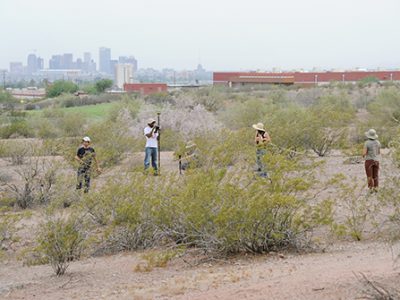
CAP fieldwork in an urban desert park

Project Summary: Many global change drivers (GCDs) lead to chronic alterations in resource availability. As communities change through time in response to these GCDs, the magnitude and direction of ecosystem responses is also predicted to change in a non-linear fashion. We propose to examine whether plant community dynamics are predictive of shifts in ecosystem function… Read more »

State Changes and Threshold Dynamics

A four-day workshop will use LTER data, including data from the EcoTrends project, to bridge the gap between the relatively mature theoretical understanding of thresholds and state changes in ecological systems and the emerging empirical databases that allow us to actually test models of state changes. Many of these changes represent “tipping points” or dramatic… Read more »

Development of a hydrochemical database – StreamchemDB

We are requesting Synthesis Working Group funds to support LTER participation in StreamchemDB. StreamchemDB is focused on aquatic chemistry data, and builds on former data synthesis projects ClimDB and HydroDB, all of which have been collaborative LTER-Forest Service cross-site synthesis and cyber-infrastructure projects.

Synthesis and Establishment of Guidelines Toward the Management of Next-Generation Sequence Data

Long-term ecological studies have expanded our view of microbial biology with the incorporation of long-term monitoring programs of diversity, plant and animal ecology, and decomposition processes in the context of global climate change. The full integration of meaningful cross-site ecological-genomic studies into LTER research will require either substantial new infrastructure or access to existing infrastructure… Read more »

Quantifying Uncertainty in Ecosystem Studies

The goal of this synthesis is to evaluate uncertainty in hydrologic inputs, outputs, and net hydrologic flux of major elements across small watersheds with diverse characteristics. The long-term goal of this project is to contribute to a cultural change in ecology that makes uncertainty analysis an accepted and expected practice in the construction of ecosystem… Read more »

Long-term Experiments in the LTER Network: Synthesis and Hypothesis Testing

We are requesting funds to assemble a working group of LTER scientists with extensive experience in conducting long-term experiments in the LTER Network, the skills and interest in synthetically interpreting the results of those experiments, and in using data from these studies to address new questions relevant to pressing global change issues.