Macrosystems ecology: A key subfield matures

Ecosystems ecology, landscape ecology, macrosystems ecology. It’s easy to think of these subdisciplines as big, bigger, biggest—but there’s a good deal more to the distinction than the scale of interaction they address. A recent “Idea and Perspective” article in Ecology Letters traces the origins and foundations of the field of macrosystems ecology, and advances a new hypothesis to describe how anthropogenic influences change the scales of ecological processes.

Putting the “urban” in disturbance: Applying ecological frameworks to cities

The concept of “disturbance” is a core theme of the LTER Network and central to ecological science. How does the idea of disturbance need to change when applied to the interactions of an urban metropolitan region rather than a “natural” system? Ecologists often consider the process of urbanization itself to be a form of disturbance, but that is a habit that has to change, say the authors of a recent paper in Ecosystem Health and Sustainability. People, technology, and infrastructure have to be defined as part of the system when studying cities, they say.

Searching for synergies: The future of long-term, large scale ecological research

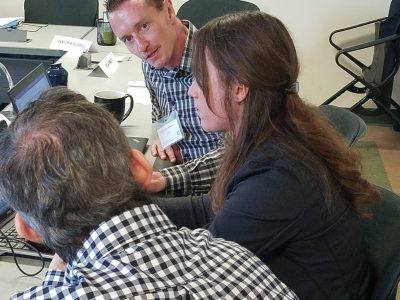
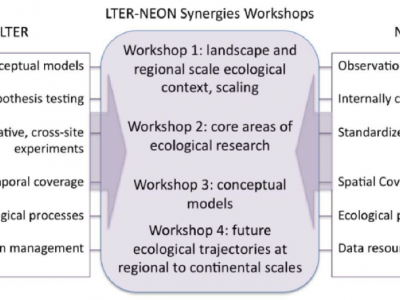
An LTER-NEON Synergies workshop, held March 29-31, explored the potential for strengthening and deepening the relationship between these two major research organizations and expanding ties to other networks such as the Critical Zone Observatory (CZO), Long Term Agricultural Research (LTAR) and Global Lake Ecological Observatory (GLEON) networks. The Long-Term Ecological Research (LTER) Network and National… Read more »

Decomposition in Streams: A Global Synthesis

leaf in streamwater

A major multi-site analysis of leaf litter decomposition in streams and rivers found that rising temperatures are unlikely to speed decomposition as much as predicted under metabolic theory. Although fresh water bodies cover only three percent of the Earth’s land surface, they are a key component of the global carbon and nutrient cycles and the rate of decomposition in streams affects both carbon dioxide emissions and supply of organic matter to downstream food webs.

Announcing 2017 Synthesis Working Groups

With more than 36 years of continuous data collection across many biomes, the Long Term Ecological Research (LTER) Network is a rich source of information for testing big-picture concepts about how ecosystems work. Luckily, the Network also brings together a group of scientists with creative ideas about how to wring new insights from diverse data… Read more »

LTER-NEON Synergies Workshop

The LTER and NEON Networks are seeking participants, especially early career scientists, for a workshop to explore synergies between the National Ecological Observatory Network (NEON) and the Long Term Ecological Research (LTER) Network. The workshop will take place at the National Center for Ecological Analysis and Synthesis/LTER National Communications Office located in Santa Barbara, CA… Read more »

Questions from the RFP Webinar

chat icon

RFP Deadline: Wednesday, October 5, 2016 (1) This is the second RFP this year. How often will you have a call for proposals? From here forward, we plan to have an annual call for proposals. (2) Currently, we have an NSF grant funded for cross-site research. We would like to get the group together for… Read more »

Call for Synthesis Proposals 2016

Long Term Ecological Research Network Communications Office (NCO) Call for Working Group Proposals In this packet, you will find all the information needed to submit a proposal to the NCO. Overview and Deadlines | Guidelines for Proposals | Synthesis Working Group | Download as pdf Informational Webinar February 12 at 8:30 a.m. PST (11:30 a.m. EST)  Missed the webinar? See the webinar… Read more »

New Participants Welcome: Synthesis Ideas from Science Council Breakout Sessions

crowded auditorium

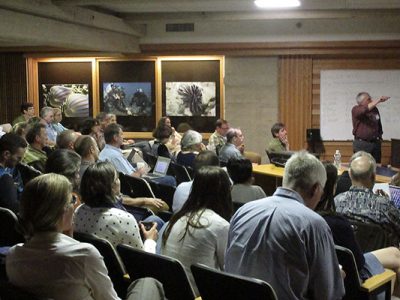
Breakout sessions from the Science Council meetings often evolve into synthesis working groups. The 2016 meeting was no exception, with a lively and challenging series of discussions resulting in six potential synthesis groups. If any of the descriptions below pique your interest, please follow up with the designated lead scientist or correspondent. How Do Abiotic Factors… Read more »

Global Patterns Figure Prominently in 2016 Synthesis Working Groups

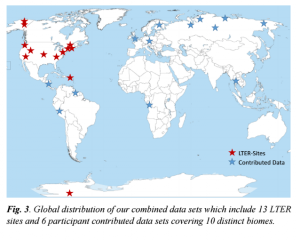
In January, as part of its mission to enhance collaboration across the LTER network, the NCO called for Synthesis Working Group proposals. The request elicited 24 highly competitive proposals that together harnessed data from all 24 LTER sites. Selection was based on scientific merit, contribution to LTER Network science, and use of novel approaches. We… Read more »