Display events on your blog.

LTER Network Roadmap 2026-2035: LTER Community Call
January 14, 2026 @ 9:00 am-10:00 am –

Announcing the new LTER Network Roadmap. What is the LTER Network beyond a collection of (amazing) sites and what are our collective goals? The new LTER Network Roadmap attempts to answer that question and lays out a series of activities to capitalize on the combined strengths of LTER sites, community, and partners. The plan includes contributions from many corners within the Network and from partners external to the Network.

Please join this LTER Network Community Call to hear and discuss our planned next steps and how you can get involved.
————————————————————————
The LTER monthly community call provides an opportunity to hold seminars, discussions, and learning opportunities of relevance to the broad LTER research community. These may include research seminars, discussions of emerging projects and methods, or the occasional organizational update.
Site Exchanges

LTER colors with graphic of multimple location markers overlayed.

February 11, 2026 @ 9:00 am-10:00 am –

Each year, the LTER Network Office offers opportunities for researchers, students, or staff to propose a project that requires travel to another site. Projects include piloting cross-site sampling efforts, developing distributed experiments, sharing of lab and field methods, cooperating on joint projects, shadowing another individual, and intensive mentoring.

The community call will include an overview of the opportunity and the chance to hear from 2025 recipients about their projects:

  • Mingyu Zhang, a doctoral student with Dr. Peter Raymond at the Plum Island LTER, traveled to the Virginia Coast Reserve LTER to improve models of carbon transport and compare methods for measuring air-water gas exchange.
  • Dr. Marguerite Mauritz, an investigator at Jornada LTER, will spent 10 days working with Dr. Marcie Litvak at the Sevilleta LTER to improve techniques for measuring CO2 exchange in drylands.
  • Alexandra Cabanelas Bermudez, a doctoral student with Dr. Heidi Sosik at the Northeast Shelf LTER will traveled to the California Current LTER to learn the ZooScan plankton imaging system.
  • Margaret Baker, a doctoral student with Sven Kranz at the California Current LTER, travelled to Dr. Tom Kelly’s lab at the Northern Gulf of Alaska LTER to build skill in – and improve tools for using – bio-optical sensors in marine systems.

~~~~~~~~~~~~~~~~~~~~~~~~~~~~~~~~~~

The LTER monthly community call provides an opportunity to hold seminars, discussions, and learning opportunities of relevance to the broad LTER research community. These may include research seminars, discussions of emerging projects and methods, or the occasional organizational update.
2025-2026 Synthesis Groups, Part A: LTER Community Call

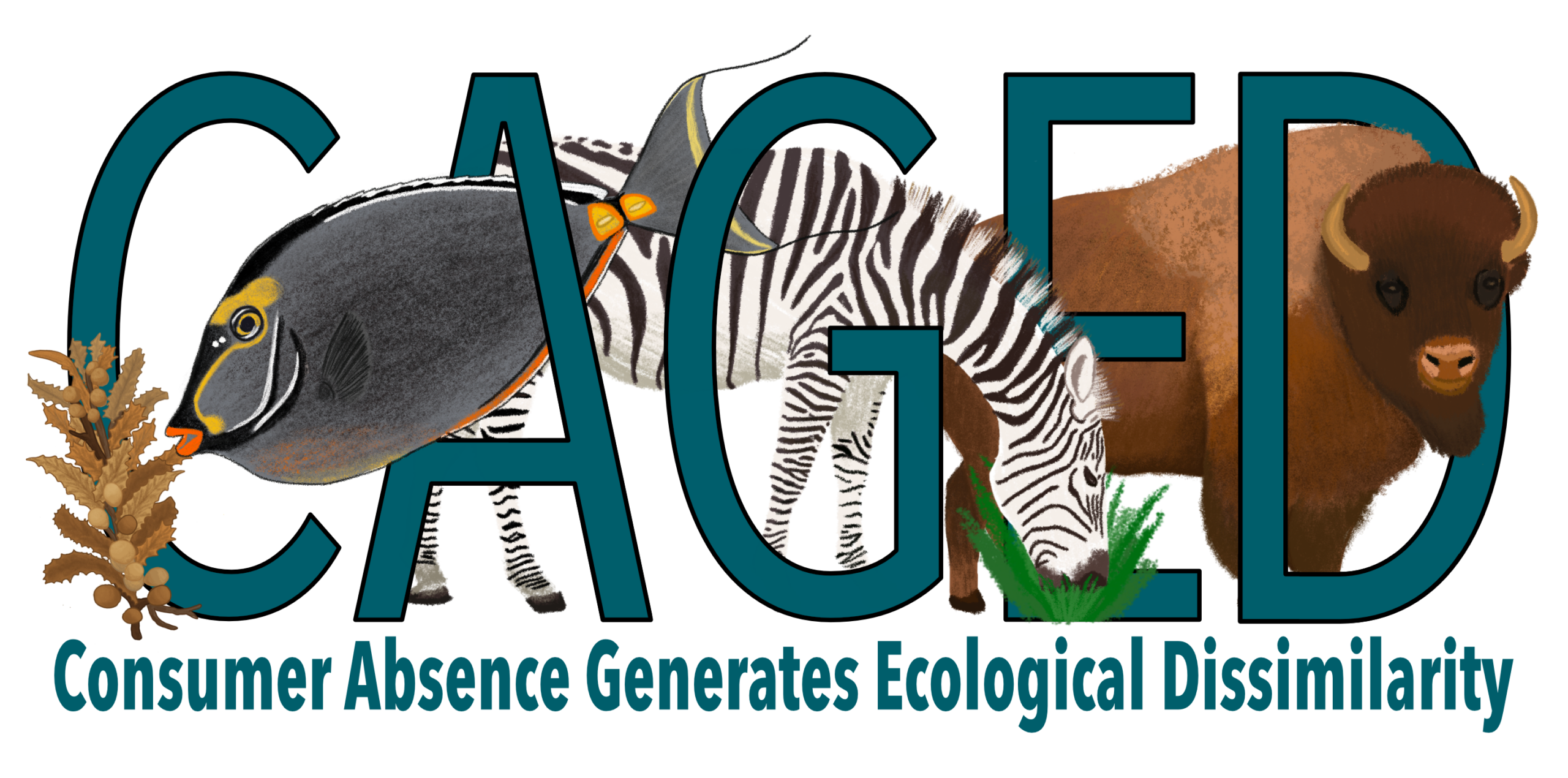
working group logo, including title (Consumer Absence Generates Ecosystem Dissimilarity) and multiple terrestrial and marine consumers.

March 10, 2026 @ 10:00 am-11:00 am –

LTER synthesis working groups bring together data from LTER and other research to discover common principles and mechanisms guiding how ecosystems function. For the March LTER Community Call, we’ll hear from two of our current synthesis groups.

working group logo, including title (Consumer Absence Generates Ecosystem Dissimilarity) and multiple terrestrial and marine consumers.A CROSS-ECOSYSTEM SYNTHESIS EXPLORING CONSEQUENCES OF CONSUMER LOSS ON COMMUNITY VARIABILITY

Presenters:

~~~~~~~~~~~~~~~~~~~~~~~~~~~~~~~~~~~~~~~~~~~~~~~
INTEGRATING ABOVE- AND BELOW-GROUND COMMUNITY DATA TO UNDERSTAND TEMPORAL DYNAMICS AND RESPONSES TO GLOBAL CHANGE

This working group evolved out of a group project in the Synthesis Skills for Early Career Researchers (SSECR) course.

Interconnectedness between plant and microbial communities is increasingly recognized as a key indicator of ecosystem functioning and stability, however few studies investigate both components simultaneously and repeatedly over time. This limits our ability to understand how above- and below-ground communities interact and respond to environmental change, and presents a clear need for a unifying framework to understand these communities in tandem. Our working group is focused on synchrony between plant and soil microbial communities, the extent to which community fluctuations align in direction and magnitude, and aims to address these knowledge gaps. We will share progress from two complementary efforts: 1) A case study exploring how synchrony varies across environmental contexts and disturbance regimes, and 2) a perspective piece proposing a conceptual framework for synchrony that integrates both plant and microbial communities.

In addition, we will present preliminary findings from a data discovery effort that highlights the critical need for more long-term, coupled datasets that track plant and microbial dynamics over time. Together, this work will lay the groundwork for a more integrated understanding of how above- and belowground communities co-vary through time and contribute to ecosystem stability, recovery, and resilience in response to global change. 

Speaker Bios

McKinley Nevins is a PhD candidate in Plant Biology in the School of Biological Sciences at Washington State University. Her research has combined above- and below-ground perspectives to improve understanding of the drivers of tree demography in the Northwestern U.S.
Headshot of McKinley Nevins
Ashley Bulseco is an Assistant Professor in Coastal Microbial & Ecosystem Ecology in the Department of Biological Sciences at the University of New Hampshire. Her research focuses on microbial community responses to disturbance and their shifting roles in biogeochemical cycling, particularly in coastal ecosystems.
headshot of Ashley Bulseco
Kaitlyn McKnight is a Ph.D. candidate in the Botany Department and the Program in Ecology and Evolution at the University of Wyoming. Her research examines how climate change reshapes ecological synchrony across spatial and temporal scales, with a focus on tree populations and grassland communities. She integrates long-term datasets with wavelet-based analyses and structural equation modeling to uncover the mechanisms linking climate variability to ecosystem stability and extinction risk.
headshot of Kaitlyn McKnight

———————————————————————
The LTER monthly community call provides an opportunity to hold seminars, discussions, and learning opportunities of relevance to the broad LTER research community. These may include research seminars, discussions of emerging projects and methods, or the occasional organizational update.
LTER Synthesis Opportunity Informational Webinar

March 25, 2026 @ 9:00 am-10:00 am –

We’ll provide an overview of the 2026 synthesis request for proposals, including the application and selection process, types of support available, and an opportunity to ask questions and make connections.

Education and Outreach Committee

April 2, 2026-April 1, 2027 @ 12:00 pm-1:00 pm –

The LTER Education and Outreach Committee meets on the first Thursday of each month to exchange information, ideas, and inspiration. Whether you are formally an education/outreach manager or a grad student, faculty or researcher with an interest in education and engagement at LTER sites, please join us.

Find additional information on the Education/Outreach Committee page, or reach out to committee chairs or the LTER Network Office to learn more. Request to join the Education/Outreach Committee Mailing list for access to calendar invitations and updates.

Arts and Humanities Working Group w/ David Bayles

April 2, 2026 @ 12:00 pm-1:00 pm –

The LTER arts and humanities working group will host the next virtual get-together in our workshop series on April 2 at 3pm EST/12pm PST for those interested in advancing arts-humanities work within their sites and across the network.
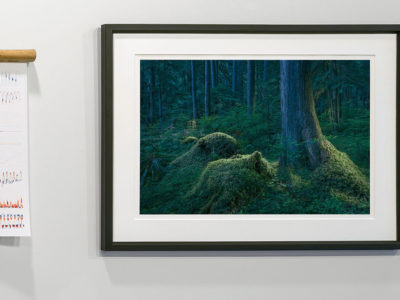
Photographer David Bayles and scientist Fred Swanson of Andrews Forest LTER will co-present featuring David’s Old Growth Dialogue project and their collaborative project Following Fire: A Resilient Forest / An Uncertain Future.  Check them out on David’s webpage (https://www.davidpaulbayles.com).  They will also introduce their collaboration with theologian Vince Miller resulting in a book chapter titled “After the fire: Wonder, ecological grief and place-based interdisciplinary research in the Anthropocene” to appear in the forthcoming Routledge Handbook of Health and Environmental Humanities. Fred will briefly introduce the use of a dozen works by four artists, including David, in an exhibit and a talk at Oregon State U on the topic “What have we learned from decades of forest research?” featuring inquiry at Andrews Forest.
If you are interested in staying in the loop for this and future communications from the LTER AH working group, feel free to fill out this form linked here to add your email to our list!

2025-2026 Synthesis Groups, Part B: LTER Community Call

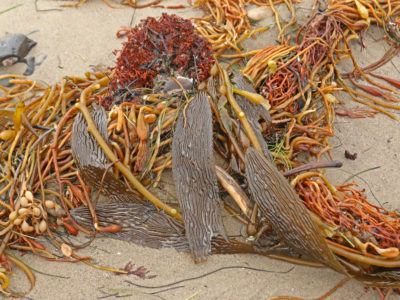
Close up of kelp fronds

April 8, 2026 @ 9:00 am-10:00 am – We’ll hear from 2 LTER synthesis groups: 1) Life after death: how legacies of dead foundation species influence ecological processes across marine and terrestrial ecosystems Presenters: – Kai Kopecky, ESIIL Postdoctoral Associate – Ty Tuff, ESIIL – Katherine Suding, Niwot Ridge LTER 2) Temporal variation in taxonomic and functional diversity and nutrient cycling of consumers […]

Flash Talk Friday

April 24, 2026 @ 12:00 pm-1:15 pm –

Organized by and for LTER Graduate Students, but all are welcome!

Everyone is encouraged to join us on April 24th for flash talks from graduate students across the LTER network! This event will be a great opportunity to learn more about exciting research happening at other sites, make connections, and build community.